
Comparative Analysis of Scheduling Algorithms in 5G Uplink Transmission

(This article belongs to the Special Issue on Special Issue on Multidisciplinary Sciences and Advanced Technology 2022 and the Section Telecommunications (TEL))
Export Citations
Cite
Mamode, M. I. S. and Fowdur, T. P. (2022). Comparative Analysis of Scheduling Algorithms in 5G Uplink Transmission. Journal of Engineering Research and Sciences, 1(5), 41–51. https://doi.org/10.55708/js0105005
Maryam Imran Sheik Mamode and Tulsi Pawan Fowdur. "Comparative Analysis of Scheduling Algorithms in 5G Uplink Transmission." Journal of Engineering Research and Sciences 1, no. 5 (May 2022): 41–51. https://doi.org/10.55708/js0105005
M.I.S. Mamode and T.P. Fowdur, "Comparative Analysis of Scheduling Algorithms in 5G Uplink Transmission," Journal of Engineering Research and Sciences, vol. 1, no. 5, pp. 41–51, May. 2022, doi: 10.55708/js0105005.
5G is the successor to 4G technology and it has enabled a new level of user experience with much greater speeds and much lower latencies. Scheduling is the method of allocating resources for transmission of data. In this paper, three scheduling algorithms have been investigated, namely Proportional Fair, Round Robin and Best CQI. An uplink 5G system with one base station and four user equipment were used to evaluate the three algorithms by varying four sets of parameters. Simulation results showed that the Round Robin algorithm was the fairest of all three algorithms by displaying almost similar resource share percentage for the four user equipment. Proportional Fair algorithm was observed to yield a higher throughput than the Round Robin algorithm for a specific user in some cases. It offered a better trade-off between throughput and fairness. In the case where distance of user 1 from the base station was 100m, the system simulated with the proportional fair technique yielded a peak throughput 30% higher than the system simulated with Round Robin technique. On the other hand, the Best CQI algorithm displayed a peak throughput value about 35% higher than the proportional fair algorithm for the 100m distance case. The Best CQI algorithm was found to be the least fair of all three algorithms as it favored users with better channel conditions.
1. Introduction
5G is the 5th generation of mobile communications which was presented in 3GPP Release 15. It enabled three key technologies namely Enhanced Mobile Broadband (eMBB), Enhanced Machine Type Communication (eMTC) and Ultra-reliable Low Latency Communication (URLLC). eMBB provides high speed internet connectivity as well as virtual reality and augmented reality media and greater bandwidth. It includes the use of Massive Multiple-Input Multiple-Output (MIMO) antennas, technology, beamforming and mmWave [1]. eMTC provides low power consumption for machine type communication with more coverage and high data rate while URLLC offered much higher Quality of Service (QoS), enabling applications such as remote surgery and intelligent transport system. eMTC also involves Internet of things (IoT) which provides connectivity between different machines without human intervention [1]. Release 16 has provided enhancements with regards to 5G satellite access, wireless convergence for 5G, Local Area Network interworking, network slicing and IoT, among others [2]. Release 17 has presented enhanced NR (New Radio) MIMO, enhanced URLLC, User Plane Function (UPF) enhancement, Network slicing phase 2 and Narrowband IoT (NB-IoT), among other improvements [3]. Release 18 has launched 5G-Advanced and works are expected to be completed by 2023 [4]. 5G has achieved peak data rates of 20 GB/s, which is about 20 times faster than 4G networks. The user experience is 10 times faster than 4G with a data rate of 100 Mbit/s. 5G has also enabled simultaneous connection for 1 million devices per square kilometre and a latency of 1m/s [5]. Cisco has predicted that 500 billion devices will have internet connectivity by 2030 while Ericsson has predicted that 29 billion devices will be connected to the internet by 2022 and 60% of that number will be related to IoT [5]. 5G has been developed for a broader range of applications compared to 4G which had primarily been developed for mobile communications [6].
Scheduling deals with the assignment of resources for transmission of data. The main objective of a scheduler is to provide an optimized allocation of resources for the User Equipment (UEs) in terms of time, frequency and power, while maintaining a satisfactory Quality of Service (QoS) level [7]. Schedulers in the Base station control the allocation of resources among users while mitigating intra-cell interference. They use different sources of information in order to assign resources and coordinate transmission.
In [8], the authors have developed a new Proportional Fair (PF) algorithm that is able to dynamically adjust for the capacity improvement of the Long Term Evolution (LTE) system. The proposed technique is compared with traditional PF downlink scheduling algorithm and Best Channel Quality Indicator (CQI) scheduler. The new method improved the average cell throughput by 31% at the expense of some degradation in the fairness level as compared with traditional PF algorithm. The authors in [9] compiled a survey of downlink scheduling algorithms. The algorithms were separated into QoS aware and QoS unaware. QoS aware makes use of the data rate, buffer status and CQI to ensure a good throughput. QoS unaware, on the other hand, utilizes the same parameters as QoS aware but in addition to those, it also uses delay constraints as well as CQI to meet the required throughput. A comparative analysis of all related scheduling algorithms had been carried out. The study has shown that QoS aware algorithms are not suitable for wireless multimedia traffic as QoS requirements are not taken into account while QoS aware algorithms do not consider the non real-time traffic. The authors in [10] proposed an enhanced PF scheduling algorithm constructed from the Latency-Rate server theory and system characteristics defined in the LTE standard. The proposed scheme was compared with PF and Modified Largest Weighted Delay First (M-LWDF) schedulers, while the rate for each user was calculated based on traffic characteristics and delay required. Simulations showed that the novel scheme outperformed the other two scheduling algorithms by meeting the delay required by users. In [11], the researchers compiled state of the art downlink scheduling algorithms and identified their challenges. An optimized solution was then developed such that the flow deadlines could be met and the solution was added to the scheduling algorithms. The buffer state for each user as well as the strict deadlines for packets were considered. Simulations have showed that the existing scheduling algorithms using the proposed solution outperformed the traditional algorithms in terms of throughput, packet loss and fairness. In [12], the authors used a Model Based Design (MBD) and Model Based Testing (MBT) method in order to investigate several scheduling algorithms which take into consideration the QoS requirements of each user and the channel conditions. Maximum Rate (MR), Round Robin (RR) and PF algorithms are evaluated as well as a new UE-based MR algorithm. Simulation results showed that the scheduling algorithms can be further enhanced using the MBD and MBT method. The authors in [13] combined the buffer status with the PF algorithm in order to generate a novel scheduling algorithm for efficient eMBB use. The efficacy of the novel algorithm was then investigated through simulations, taking into account the throughput, fairness and buffer status. In [14], a novel scheduling algorithm was developed and it considered priorities and deadlines in order to assign resources to users. The researchers in [15] proposed a novel scheduling technique which was able to choose a specific scheduling algorithm based on instantaneous scheduler states so that packet drop rates and packet delays were minimized. Reinforcement learning is used to map the scheduling algorithm to each state for real-time scheduling and also to learn when each state should be applied. In [16], the RR and PF scheduling techniques were compared for varied UE density scenarios using voice and video traffic, in order to evaluate the performance of 5G mmwave network. Simulation results showed that RR was the preferred choice for voice traffic while PF was selected for video traffic due to better throughput results.
In this paper, three scheduling algorithms have been investigated namely PF, RR and Best CQI. An uplink 5G system has been used to simulate the three algorithms. The “NR PUSCH FDD Scheduling” program in Matlab was used to carry out simulations. Four sets of parameters were identified in the program and were investigated. Thus four schemes have been implemented whereby the four sets of parameters were varied individually while keeping other relevant parameters constant. The four sets of parameters that were varied are as follows:
- Distance of the UE from the base station
- Size of packets transmitted
- Total Bucket size : Prioritized bit rate (PRB) and Bucket size duration (BSD)
- The priority of each logical channel.
The simulation results were analysed in terms of goodput, throughput, Resource Share percentage and Buffer Status. Simulation results showed that in all cases, the RR algorithm displayed almost similar resource share for all UEs. The PF algorithm, however, showed better throughput values for particular UEs by considering the scheduling factors. The Best CQI algorithm largely considered channel conditions and thus it was observed that the user with better CQI yielded much better throughput than the other users.
The rest of the paper is organized as follows. Section 2 presents scheduling in 5G. It elaborates on the scheduling factors, processes and techniques. Section 3 deals with simulation results and analysis. Section 4 concludes the paper.
2. Scheduling in 5G
In order to allocate resources to a specific user, there are various factors to be considered such as Measurement (UE/Network), BSR (Buffer Status Report), QoS Requirement, Associated Radio Bearer, CQI and SR (Scheduling Request) among others. The CQI helps to select the appropriate Modulation and Coding Scheme (MCS) to be used on the resource block allocated to the user. The buffer status report is used by the user to inform the base station in case there is some data in its buffer in order to request a grant from the network to transmit the data. Thus, the base station is constantly informed about the buffer status of the UE. The QoS determines how a data packet is treated in the network. Web browsing packets are given lower priority than voice packets. The scheduler depends on the BSR, CQI and QoS in order to make an appropriate scheduling decision [17].
For the allocation of resources during the scheduler operation, both the UE buffer status and QoS requirements of each UE and associated radio bearers, are considered. Measurements at the base stations or made by the UE, are used to determine radio conditions at the UE. Those measurements can then also be used to allocate resources. Radio resources are assigned in a unit of slot (for example one mini-slot, one slot, or multiple slots) and the radio resources are made up of resource blocks [18].
The UE will receive a scheduling channel following a scheduling request and the resources assigned can be determined from the scheduling channel. The uplink buffer status reports form part of the measurements used for the scheduler operation. These reports are used to evaluate the data buffered in the UE’s logical channel queues in order to create Qos-aware packet scheduling. There are two types of logical channels namely logical control channel and logical traffic channel. The logical control channel is used for transmitting control plane information. The control channels consist of the Broadcast Control Channel (BCCH), the Common Control Channel (CCCH) and the Dedicated Control Channel (DCCH). The logical traffic channels are used to transmit user plane information. The Dedicated Traffic Channel (DTCH) is a point-to-point channel for the transmission of a particular user’s information. It can be used both in downlink and uplink.
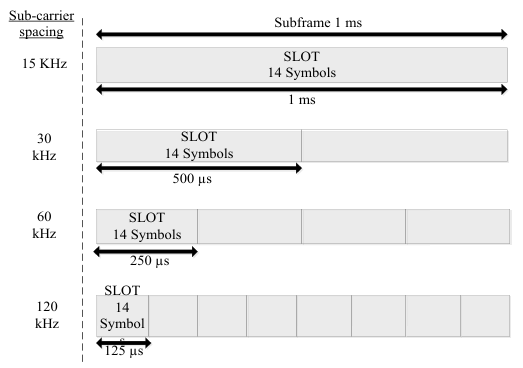
Two categories of scheduling are defined for 5G namely Time-domain and frequency domain [19]. A resource block in 5G can be defined as a group of twelve sub-carriers which are contiguous in frequency, over one slot in time. It constitutes the smallest unit of radio resource and can be built up into radio frames, subframes, slots and mini-slots. The radio frame has a duration of 10ms and constitutes 10 subframes with each subframe of a duration of 1 ms. Each subframe contains one or more adjacent slots containing 14 OFDM symbols. A mini-slot in Release 15 contains 2, 4, and 7 OFDM symbols and the time duration of a slot depends on the sub-carrier spacing as illustrated in Figure 1 [20].
The resource element mapping takes place in the Physical Downlink Shared Channel (PDSCH) for downlink transmission and in the Physical Uplink Shared Channel (PUSCH) for uplink transmission, before OFDM signal generation [21]. The Uplink scheduling strategy has the task of allocating PUSCH resources to a group of UEs related to a gNB. The schema of a scheduling system is shown in Figure 2 [22].
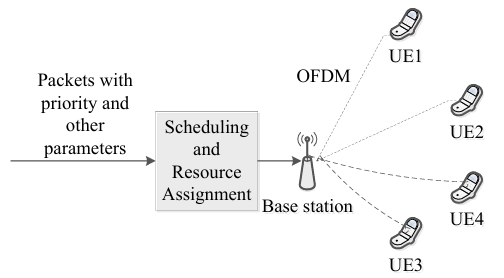
From Figure 2, it can be observed that packets are input to the scheduler of the base station. Each packet is destined for a particular user with specific characteristics in terms of priority, distance and packet size. Beamforming is used to transmit packets to the UEs and four UEs are used in the 5G system architecture simulated.
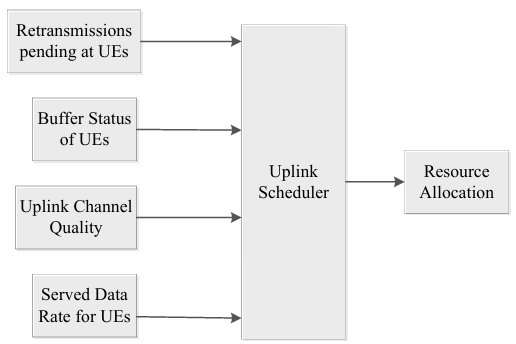
The function of the gNB is to assign uplink resources by using the scheduling algorithm. Uplink assignments are sent to the UEs and PUSCH transmission is received from the latter. The tasks of the UEs is to transmit the pending buffer status report to the gNB and collect the uplink assignments from the gNB, which is used for PUSCH transmission. The scheduler is used every p slots to allocate resources where p denotes the periodicity of the scheduler. In each period, the periodicity p matches the number of slots scheduled. Figure 3 shows a schema of the Uplink scheduler function [22].
The RR algorithm is used to allocate resources equally between all users without any consideration towards the channel conditions. The RR algorithm provides fairness to all UEs and it operates by rotating the queue process. When a process ends, the next process is handled and each process is allocated the same time period. An equation is used to define the user priorities for each resource block in terms of user i and resource block k [16].
$$x_{i,k} = y_i(t – T_i) \tag{1}$$
where 𝑦𝑖 represents the priority value for each process for user i
t represents the current time
Ti represents the last time user i was served.
The Proportional Fair (PF) algorithm has the primary objective of achieving a fair trade-off between throughput and fairness. The PF scheduler assigns resources to UEs according to the average achievable data rate and thus it also serves UEs having very low CQI values [13]. The throughput of UEs having better instantaneous achievable rate are increased compared to mean throughput. The PF algorithm does not take into account the buffer status of the UE and thus it is not optimal for real time services. It considers the ratio of the user’s instantaneous transmittable data rate to average transmitted rate, in order to schedule users.
The scheduling formula for PF is represented by equations below.
$$x_i(t) = \frac{y_i(t)}{z_i(t)} \tag{2}$$
$$\quad z_i(t+1) = \left(1 – \frac{1}{t_c}\right) z_i(t) + w_i(t+1) * \frac{1}{t_c} * y_i(t+1) \tag{3}$$
$$\quad w_i(t+1) = \begin{cases} 1 & \text{when packets of user } i \text{ are allocated at interval } t+1 \\ 0 & \text{when packets of user } i \text{ are not allocated at interval } t+1 \end{cases} \tag{4}$$
where: 𝑦𝑖(𝑡) represents the momentary data rate for user i calculated during time interval t,
z𝑖(𝑡) indicates the mean throughput of user i during time interval t,
w𝑖(𝑡+1) indicates the selection of the packet for transmission during time interval t+1,
tc denotes a time constant which can be used to capitalize on throughput and fairness with the PF algorithm.
The Best CQI algorithm selects the user who has the highest CQI. This algorithm basically schedules resources based on feedback report from the UE on the radio channel quality such as BER, CQI and SINR. The resource assignment depends essentially on the channel condition or radio signal power and thus fairness is not a priority for this algorithm. In the 5G-NR standards, CQI vs MCS (Modulation and Coding Scheme) tables are already defined. According to the CQI value reported by the UE, the different transport block sizes are selected to transmit data. In case a high CQI value is reported, a larger transport block size is used to transmit data [23]. Thus the users at edges of a cell with bad channel conditions will not get assigned any resources [24].
The following equation can be used to illustrate the Best CQI algorithm.
$$n = \max_{t=1 \text{ to } N} \left( P_i(t) \right) \tag{5}$$
where n is the user, p𝑖(𝑡) is the achievable data rate of a particular UE i at time t and N is the total number of active users.
3. Simulation Results and Analysis
Three Uplink scheduling strategies namely PF, RR and Best-CQI are evaluated in this work, in terms of throughput and fairness in frequency division duplexing (FDD) mode.
Four schemes have been simulated. Four UEs and 1 gNB, are used for simulations. For each of the schemes simulated, a set of parameters were varied and other sets were kept constant. The simulation results were displayed in terms of throughput, goodput, resource share percentage and Buffer status.
The throughput is defined as ratio of the data bits delivered successfully to the whole simulation time [13].
$$\text{Throughput} = \mathit{Throughput} = \frac{\sum \textit{Received Packet Size}}{\textit{Total Simulation time}} \tag{6}$$
The goodput illustrates the successful delivery of data packets to the UE. It does not take into consideration packet retransmissions and thus the value for goodput is lower than for throughput [25]. The goodput can be expressed as follows [13]:
$$\textit{Goodput} = \frac{\textit{Useful data transmitted}}{\textit{Total transmission time}} \tag{7}$$
The Buffer Status Report (BSR) provides the gNB with data about the amount of volume in the MAC entity. The following parameters are configured by the RRC to manage the BSR including periodic BSR Timer and retransmission BSR Timer [26]. The volume of UL data that can be allocated to a logical channel is determined by the MAC entity and computed based on the data volume calculation process in [27] and [28].
Fairness metric is used to illustrate the equal sharing of resources between all users in a communication system [13]. The most commonly used fairness metric is Jain’s index, where the level of fairness received by each stream is the flow rate attained by each flow when the simulation ends [13]. It can be expressed as follows [13]:
$$\textit{Fairness}_{\textit{index}} = \frac{\left( \sum b_i \right)^2}{a \times \sum b_i^2}$$
where bi is the user throughput and denotes the active flows.
In this simulation, the resource share percentage is calculated as a percentage of the total UL resources for each UE to illustrate the fairness of scheduling [22].
$$\textit{Resource share percentage} = \frac{\textit{Resource allocated for one UE}}{\textit{Total UL resources}} \tag{8}$$
All simulations were carried out using the 5G toolbox in Matlab.
3.1. Scheme 1
For scheme 1, the distance is varied for the 4 UEs and other parameters are kept constant. However, since the distance of a UE from the gNB is directly related to the CQI, as shown in Table 1, the CQI also changes for each UE. Table 1 has been derived from NR PUSCH FDD Scheduling function in 5G toolbox of Matlab.
Table 1: Distance vs CQI mapping
Distance | Maximum Achievable CQI value |
≤200m | 15 |
≤500 | 12 |
≤800 | 10 |
≤1000 | 8 |
≤1200 | 7 |
For each Resource block assigned, the value of CQI for a particular UE is generated randomly, limited by the maximum achievable CQI value.
The parameters used for scheme 1 is shown in Table 2.
Table 2: Parameters for scheme 1
Parameters | |
Number of frames | 200 |
Number of UEs | 4 |
Number of Logical channels | 3 |
UE distance from gNB | UE1: 100m UE1: 300m UE1: 600m UE1: 900m |
Packet periodicity | 40ms |
Packet size | 20000 bytes |
Maximum buffer length | 10240 |
Priority for logical channels | 1 |
Prioritized bitrate for each logical channel | Logical channel 1: 8kb/s for all UEs Logical channel 2: 16kb/s for all UEs Logical channel 1: 32kb/s for all UEs |
Bucket size duration for each logical channel | Logical channel 1: 5ms for all UEs Logical channel 2: 10ms for all UEs Logical channel 1: 20ms for all UEs |
Scheduler strategy | PF, RR and Best-CQI |
Bandwidth | 5MHz |
Subcarrier spacing | 15 kHz |
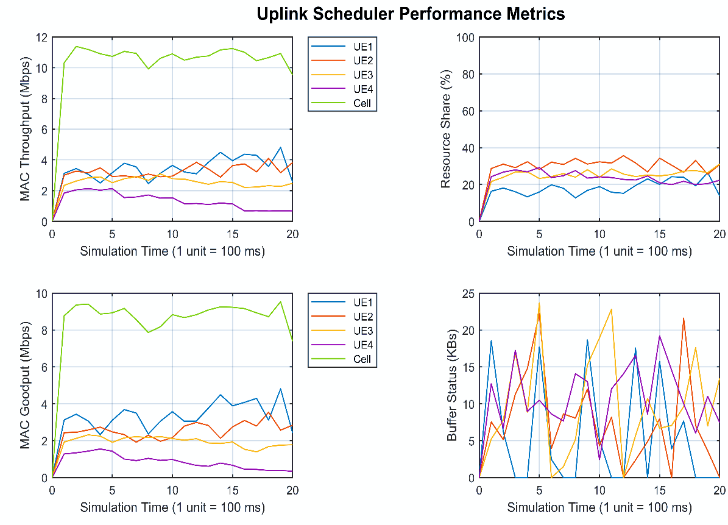
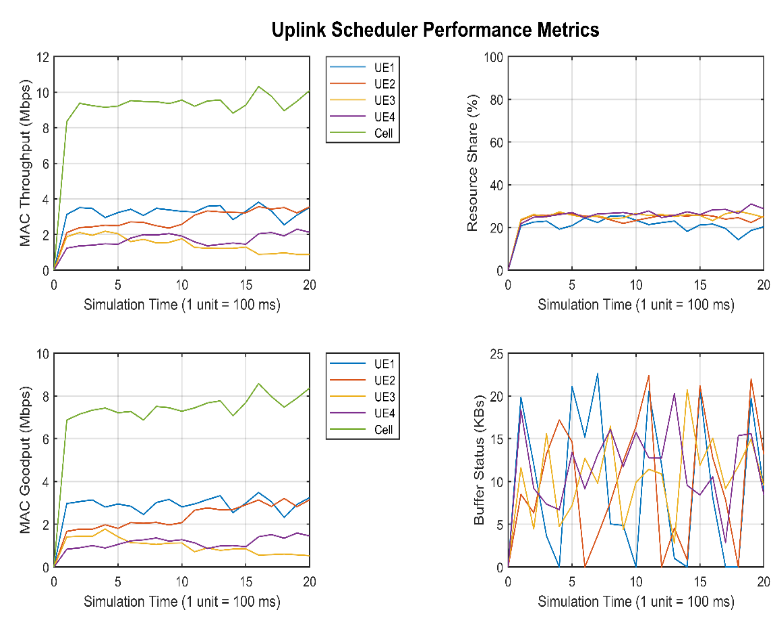
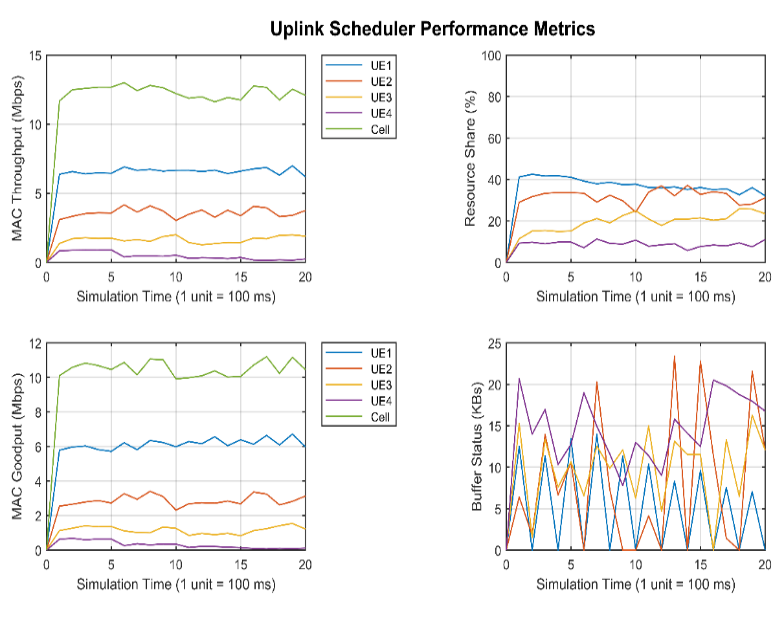
In scheme 1, UE1 was assigned the nearest distance from the gNB and hence display better CQI. Figures 4,5 and 6 show the performance of PF, RR and Best-CQI algorithms respectively in terms of throughput, goodput, Resource fairness and Buffer status, for scheme 1. It is observed that the PF and RR algorithms display almost the same performance in terms of throughput and goodput while the Best CQI algorithm noticeably differentiates the performance for each UE based on the CQI value with UE1 depicting the best performance followed by UE2, UE3 and then UE4. This is due to UE1 being closest to the gNB and hence having the best CQI values compared to the other 3 UEs. Considering the resource share percentage, it is noticed that the PF and RR strategies display almost the same resource share behaviour while the Best CQI strategy display remarkably higher percentage of resource for UE1 compared to the other UEs. Moreover, the buffer status is also low for UE1 with Best CQI algorithm.
3.2. Scheme 2
For scheme 2, the size of packets generated by the UE in each logical channel is varied and other parameters are kept constant. The parameters used for simulations are shown in Table 3.
Table 3: Parameters for Scheme 2
Parameters | |
Number of frames | 200 |
Number of UEs | 4 |
Number of Logical channels | 3 |
UE distance from gNB | 300m for all UEs |
Packet periodicity | 40ms |
Packet size | UE1: 20000 bytes UE2: 10000 bytes UE3: 5000 bytes UE4: 2000 bytes |
Maximum buffer length | 10240 |
Priority for logical channels | 1 |
Prioritized bitrate for each logical channel | Logical channel 1: 8kb/s for all UEs Logical channel 2: 16kb/s for all UEs Logical channel 1: 32kb/s for all UEs |
Bucket size duration for each logical channel | Logical channel 1: 5ms for all UEs Logical channel 2: 10ms for all UEs Logical channel 1: 20ms for all UEs |
Scheduler strategy | PF, RR and Best-CQI |
Bandwidth | 5MHz |
Subcarrier spacing | 15 kHz |
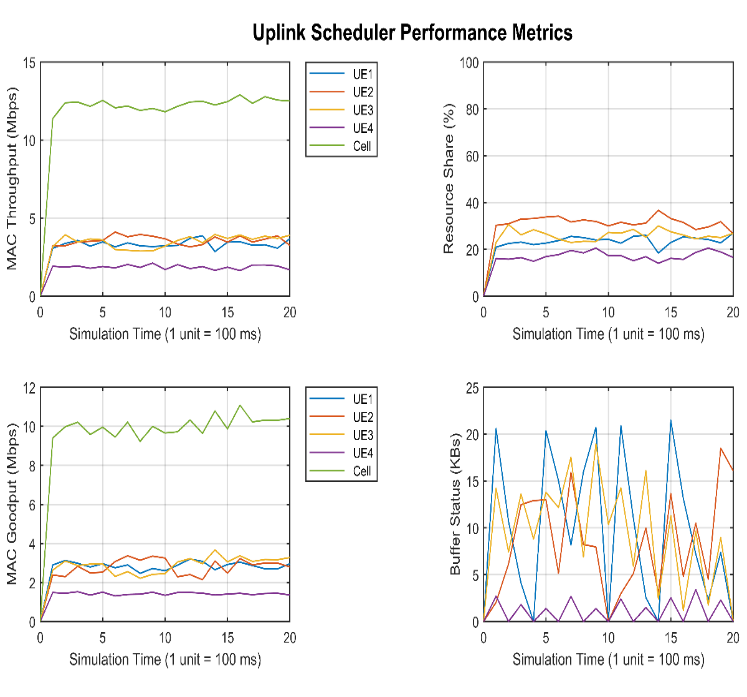
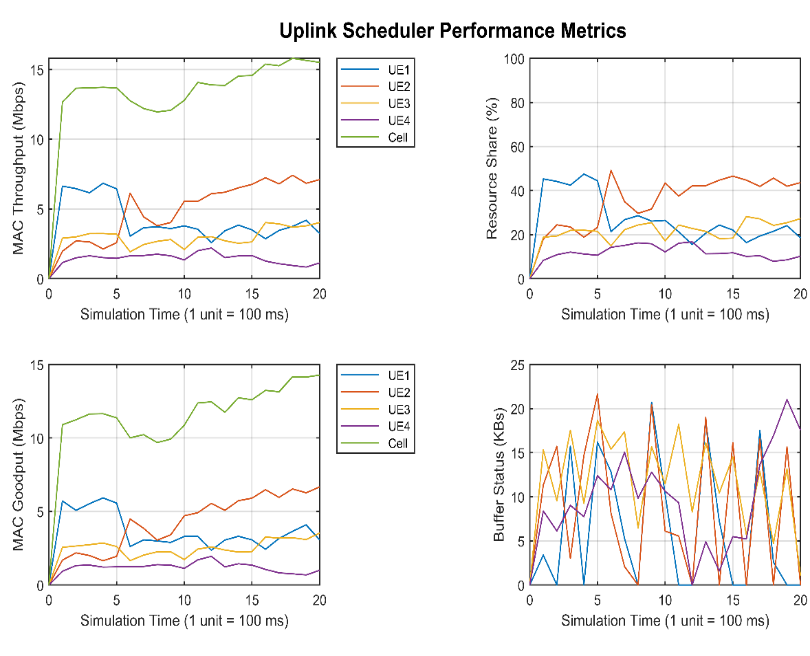
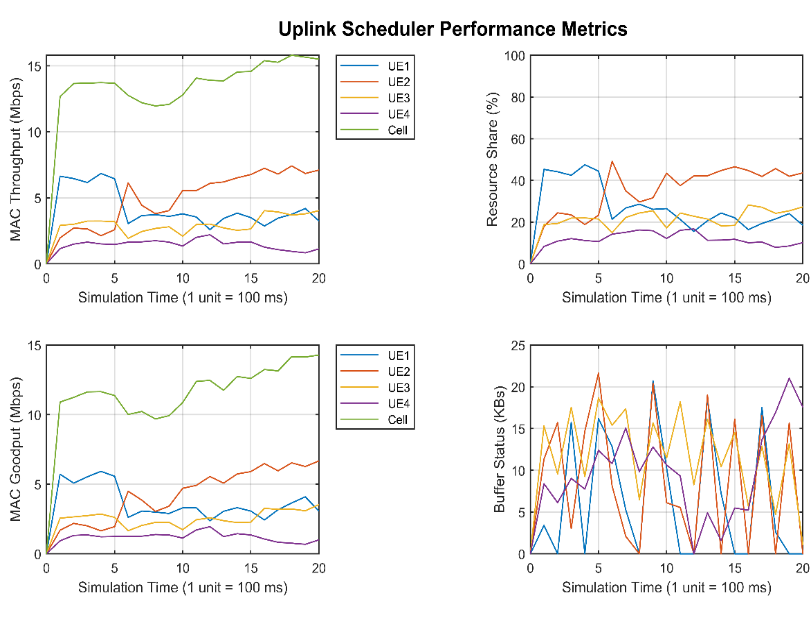
Figures 7,8 and 9 show the performance of PF, RR and Best-CQI algorithms respectively in terms of throughput, goodput, Resource fairness and Buffer status, for scheme 2. As UE1 has larger packets, it is expected that it will have higher buffer status. It is observed that the PF algorithm display the highest buffer status for UE1 with packet size 20000 bytes and lowest buffer status for UE4 with packet size 2000 bytes. However, the resource share is almost the same for all 4 UEs while UE4 has a slightly lower performance than the other UEs. RR algorithm, on the other hand display higher buffer status for UE2 and UE3 and similar buffer status for UE1 and UE4. The resource share is identical for 3 UEs except UE4 and the performance of UE1 is slightly better than the other UEs. The Best CQI algorithms shows more resources allocated to UE1 which also displays a much better performance in the first 1000ms as compared to the other UEs. Less resource is allocated to UE4 who also depicts poorer performance than all UEs. The buffer status is higher for UE2 compared to the other three UEs which display almost similar buffer status.
3.3. Scheme 3
For scheme 3, the prioritized bit rate (PBR) and the bucket size duration (BSD) of each logical channel is varied and other parameters are kept constant. The BSD is defined as the duration during which a logical channel buffers the upper layer data according to the PBR of the logical channel. The total bucket size (buffer capacity) is defined as PBR*BSD. The bucket size is utilized to avoid starvation due to prioritized logical channel.
The parameters used for scheme 3 is shown in Table 4.
Table 4: Parameters for Scheme 3
Parameters | |
Number of frames | 200 |
Number of UEs | 4 |
Number of Logical channels | 3 |
UE distance from gNB | 300m for all Ues |
Packet periodicity | 40ms |
Packet size | 20000 bytes |
Maximum buffer length | 10240 |
Priority for logical channels | 1 |
Prioritized bitrate for each logical channel | UE1: 8kb/s for all logical channels UE2: 16kb/s for all logical channels UE1: 32kb/s for all logical channels UE1: 128kb/s for all logical channels |
Bucket size duration for each logical channel | UE1: 5ms for all logical channels UE2: 10ms for all logical channels UE3: 20ms for all logical channels UE4: 20ms for all logical channels |
Scheduler strategy | PF, RR and Best-CQI |
Bandwidth | 5MHz |
Subcarrier spacing | 15 kHz |
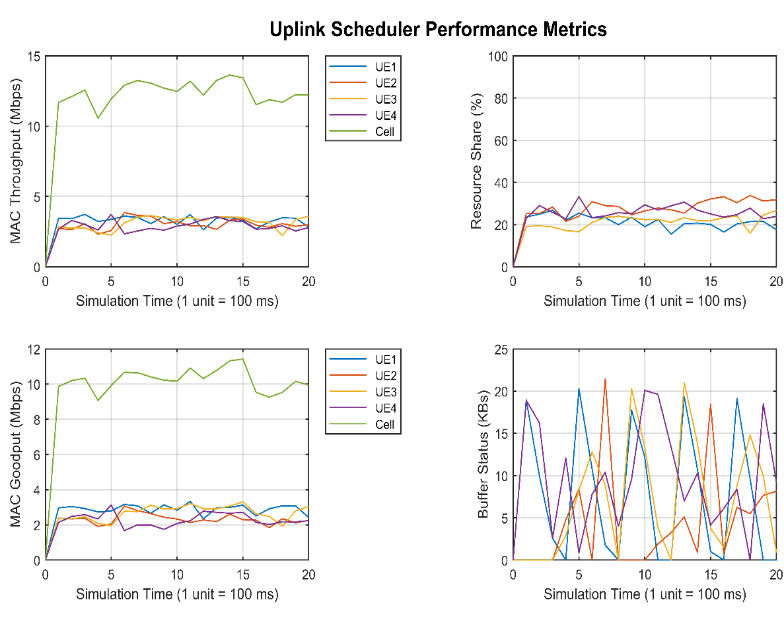
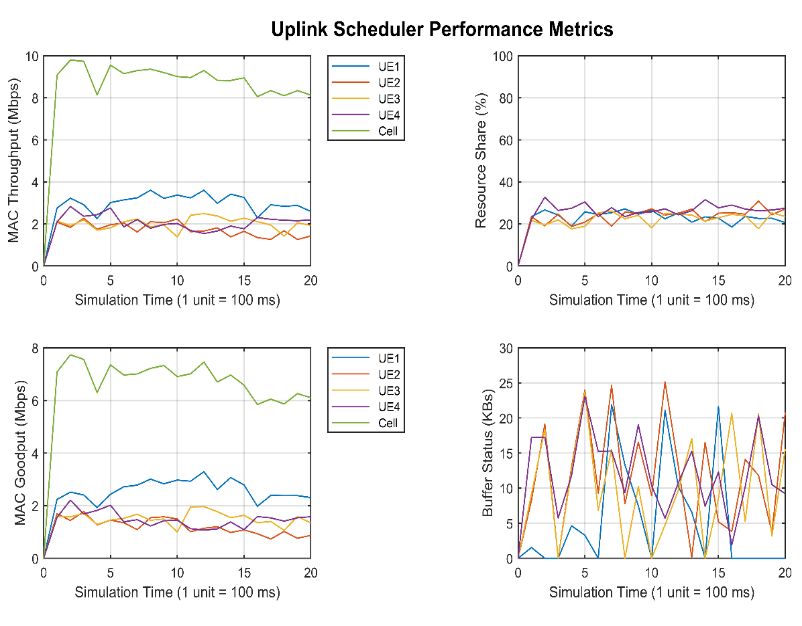
Figures 10, 11 and 12 show the performance of PF, RR and Best-CQI algorithms respectively in terms of throughput, goodput, Resource fairness and Buffer status, for scheme 3. As per the parameters configured, UE4 will have larger bucket size (128*0.02=2.56kb) compared to UE 1 (8*0.005=0.04 kb). The PF algorithm demonstrates almost similar performance for all UEs including similar resource share percentage, with a slight advantage to UE4. The buffer status is also similar for all UEs. The RR strategy displays better performance for UE1 compared to other UEs, with lowest buffer status for UE1. The resource share for UE4 is slightly higher than for the other UEs. The Best CQI strategy displays noticeably better performance and resource share for UE1 followed by UE2. The buffer status is high for UE3 and UE4.
3.4. Scheme 4
For scheme 4, the priority of each logical channel is varied and other parameters are kept constant. The data from the logical channel with the highest priority is scheduled first followed by the data from the logical channel of the next highest priority. An increasing priority value indicates a lower priority level.
The parameters used for scheme 4 is shown in Table 5.
Table 5: Parameters for Scheme 4
Parameters | |
Number of frames | 200 |
Number of UEs | 4 |
Number of Logical channels | 3 |
UE distance from gNB | 300m for all UEs |
Packet periodicity | 40ms |
Packet size | 20000 bytes |
Maximum buffer length | 10240 |
Priority for logical channels | UE1: 1 for all 3 logical channels UE2: 10 for all 3 logical channels UE3: 10 for all 3 logical channels UE4: 10 for all 3 logical channels |
Prioritized bitrate for each logical channel | Logical channel 1: 8kb/s for all UEs Logical channel 2: 16kb/s for all UEs Logical channel 1: 32kb/s for all UEs |
Bucket size duration for each logical channel | Logical channel 1: 5ms for all UEs Logical channel 2: 10ms for all UEs Logical channel 1: 20ms for all UEs |
Scheduler strategy | PF, RR and Best-CQI |
Bandwidth | 5MHz |
Subcarrier spacing | 15 kHz |
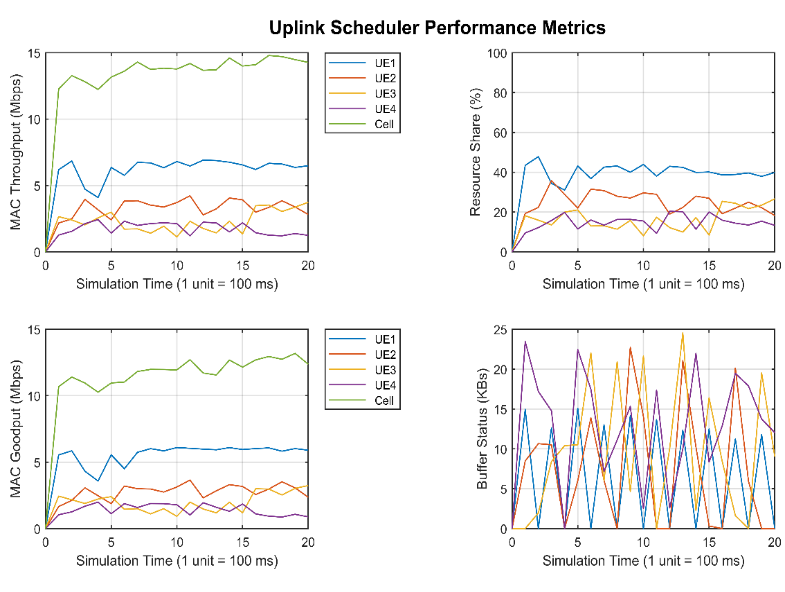
Figures 13, 14 and 15 show the performance of PF, RR and Best-CQI algorithms respectively in terms of throughput, goodput, Resource fairness and Buffer status, for scheme 4. For the PF and RR algorithms, it is observed that although UE1 has highest priority, the performance for all 4UEs are almost the same with only a slightly better performance for UE1 while the resource share for UE1 is lower than for the other UEs. The buffer status is fairly similar for all UEs. For the Best CQI strategy, UE1 displays a noticeably better performance and resource share percentage compared to the other two algorithms. The buffer status for UE1 is also much lower than for the other UEs.
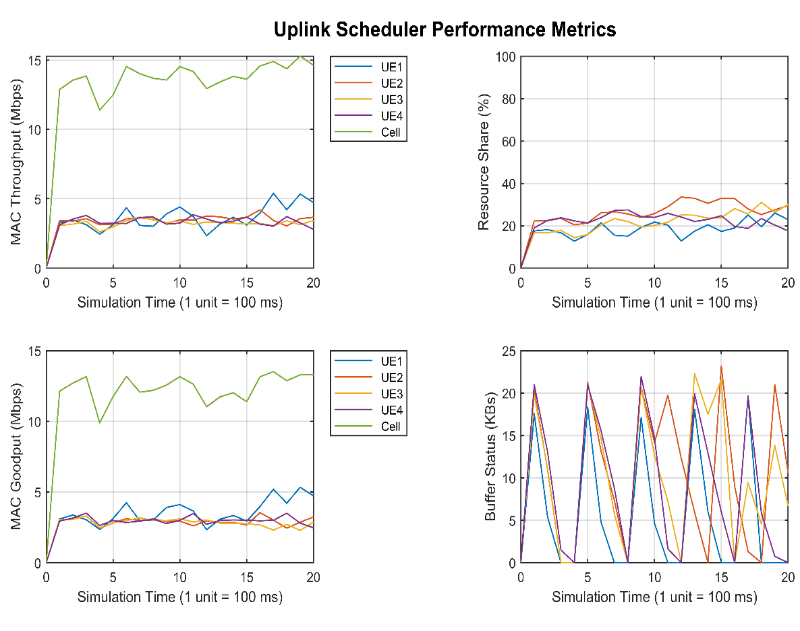
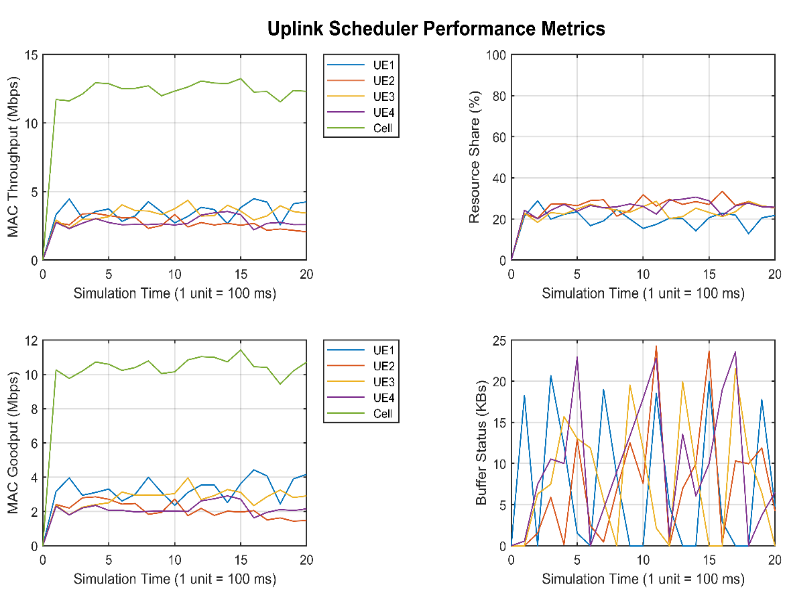
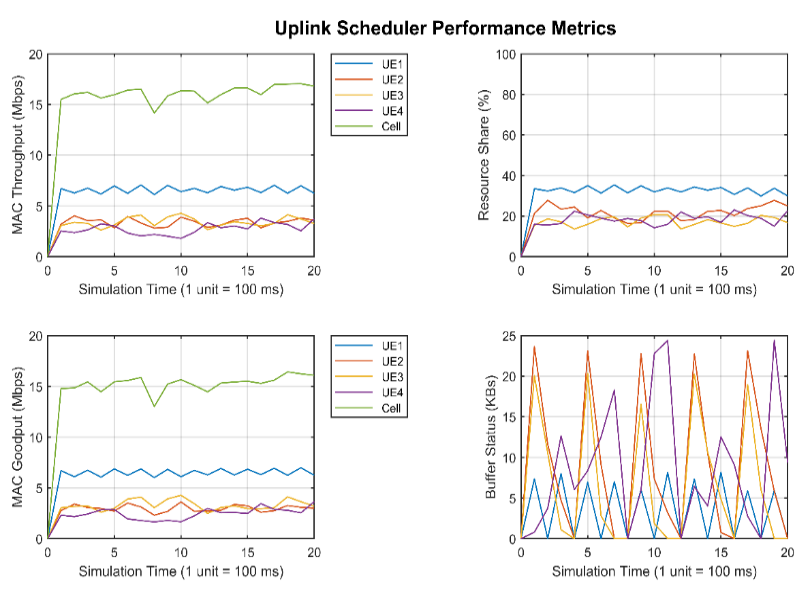
From the simulations carried out, it has been observed that the Best CQI algorithm yielded the best performance for a particular user. This is due to the fact that this algorithm prefers the user with the most favourable conditions. Thus, data transmission with good channel conditions and good quality will lead to less retransmissions and higher throughput and goodput, which is noticed in all simulation cases.
It is observed that the RR algorithm, on the other hand, allocates a data channel for transmission, irrespective of the amount of data to be transmitted. Thus, in all simulation cases, it is observed that the throughput and goodput follow almost the same trend irrespective of the size of data packets.
The PF algorithm is observed to take into consideration the size of packets to be transmitted and the priority of each user in all simulation cases. It aims to maximize the throughput of each user and thus provides a better trade-off between fairness and performance.
For further analysis, the work carried out in this paper has been compared with a similar work carried out in [13].
In [13], a downlink wireless network with one gNB, 10 UEs and a maximum bandwidth of 100 MHz was considered. The throughput, goodput, buffer status and fairness of several scheduling algorithms were compared including the three scheduling algorithms investigated in this paper. However, the authors did not display the throughput for each user as achieved in this paper as the only the minimum and maximum values were displayed. Moreover, in our case, several parameters were varied in order to illustrate the effect of each parameter on the throughput, goodput, buffer status and resource share percentage for each scheduling algorithm.
The key parameters for both papers are illustrated in Table 6.
Table 6: Parameters for both papers
Paper [12] | This paper | |
Bandwidth | 100 MHz | 5 MHz |
Subcarrier spacing | 30 kHz | 15 kHz |
Number of Frames | 100 | 200 |
Number of UEs | 10 | 4 |
The plots below show a comparison of results obtained in [13] with results obtained in this paper to illustrate whether the algorithms behave similarly in downlink and uplink, for throughput and goodput performance. In order to achieve a fair comparison, the minimum and maximum values of the users are considered for the scheme where distance was varied. There is a noticeable difference in throughput values achieved for both papers due to the different values of simulation parameters used.
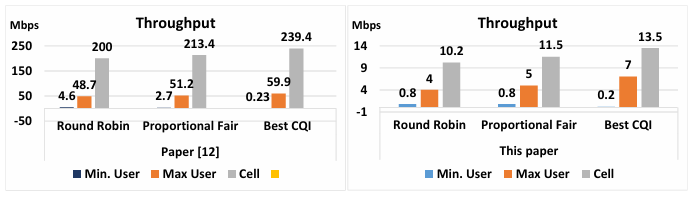
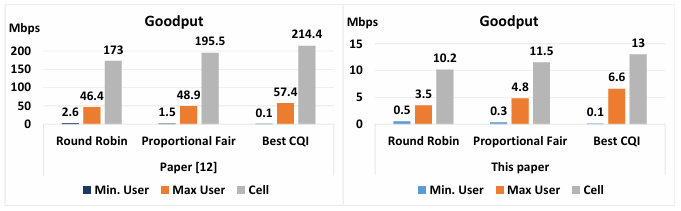
It can be seen from the results plotted that the three scheduling algorithms follow the same trend for both downlink and uplink scheduling performance.
In [29], the authors have simulated a LTE-A system using four scheduling algorithms, including the three algorithms mentioned in this paper, in LTE downlink. The results obtained in [28] for the three scheduling algorithms follow a similar trend as observed in this paper.
It is to be noted that most of the previous works so far have been done on LTE-Advanced. The three algorithms mentioned in this paper have previously been used for LTE and are currently being used for 5G as well. This work has reconfirmed the trend observed in LTE as a similar trend has been observed with 5G. For a broader analysis, more parameters have been varied in this work as compared to other papers, hence it provides insightful results to the scientific community.
4. Conclusion
This paper considered simulations using 5G systems with three scheduling strategies namely Proportional Fair, Round Robin and Best CQI. Four sets of parameters were varied. When distance was varied, the Best CQI algorithm displayed distinctive gaps in the throughput and resource share percentage for the four UEs compared with RR algorithm which displayed almost the same fairness percentage for all four UEs. The PF algorithm, gave a slightly better throughput than RR. When size of packets was varied, the PF algorithm provided a trade-off between fairness and throughput while RR algorithm displayed similar fairness for all four UEs. Moreover, the Best CQI algorithm showed better resource share percentage and throughput for the UE with highest packet. When the total bucket size was varied, the PF algorithm displayed slight gaps in the resource share percentage and almost the same throughput value for the four UEs. RR depicted a slight advantage in throughput for UE1 with the least total bucket size. When priority was varied, Best CQI algorithm showed a considerable advantage for the UE with the best priority, both in terms of fairness and throughput. A general observation made was that the PF algorithm provided a trade-off between throughput and fairness while the Best CQI algorithm offered the highest throughput than the other two algorithms while displaying a considerable preference for UEs with more favourable conditions and parameters. For future works, the authors are planning to implement machine learning algorithms together with existing scheduling algorithms mentioned in [30].
Conflict of Interest
The authors declare no conflict of interest.
Acknowledgment
The authors wish to thank the University of Mauritius for providing the necessary resources to carry out this research.
- R. Dangi, P. Lalwani, G. Choudhary, I. You and G. Pau, “Study and Investigation on 5G Technology: A Systematic Review,” Sensors 2022,22, 26. DOI: 10.3390/s22010026
- 3GPP TR 21.916, 3rd Generation Partnership Project, Release 16 description, 2020
- 3GPP TR 21.917, 3rd Generation Partnership Project, Release 17, 2021
- 3GPP TR 21.918, 3rd Generation Partnership Project, Release 18, 2022
- I. Bain, “5G: A Transformative Technology,” Barclays Corporate Bankin, 2018
- Srivastava, S., Dash, P.P. and Kumar, S., 2021, “Capacity Analysis of Non-Orthogonal Multiple Access for Uplink and Downlink,” Journal of Mobile Multimedia, pp.385-406., doi: 10.13052/jmm1550-4646.171320.
- M.M. Zafar, A. Hafeez, “Performance Investigation of Scheduling Algorithms for LTE Networks,” Journal of Networking Technology, 9(3): 73, 2018, doi: 10.6025/jnt/2018/9/3/73-84
- M. Abd-Elnaby, M. Elhadad and E. El-Rabaie, “Capacity Enhancement Based on Dynamically Adapted PF Scheduling Algorithm for LTE Downlink System,” The International Arab Journal of Information Technology, Vol. 15, No. 5, 2018.
- M.A. Lawal, I. Saidu, A. Mohammed and Y.A., “Downlink Scheduling Algorithms in LTE Networks: A Survey,” IOSR Journal of Mobile Computing & Application (IOSR-JMCA), e-ISSN: 2394-0050, P-ISSN: 2394-0042.Volume 4, Issue 3, PP 01-12, 2017, doi: 10.9790/0050-04030112
- R.P. Oliveira, L.A. Góis and A. Foronda, “Enhanced PF Scheduling Algorithm for LTE Networks.,” International Journal of Communication Networks and Information Security (IJCNIS), Vol 10, No 1, 2018, doi: 10.54039/ijcnis.v10i1.3026
- M.O. Kayali , Z. Shmeiss, Z. Safa and W. El-Hajj, “Downlink Scheduling in LTE: Challenges, Improvement, and Analysis,” 13th International Wireless Communications and Mobile Computing Conference (IWCMC), 2017, doi: 10.1109/IWCMC.2017.7986307
- C. Müller, G. Galaviz, A. Andrade, I. Kaiser, W. Fengler, “Evaluation of Scheduling Algorithms for 5G Mobile Systems”, Computer Science and Engineering—Theory and Applications, 2018, doi: 10.1007/978-3-319-74060-7_12.
- A. Mamane, M. Fattah, M. El Ghazi, Y. Balboul, M. El Bekkali, S. Mazer, “Proportional fair buffer scheduling algorithm for 5G enhanced mobile broadband,” International Journal of Electrical and Computer Engineering (IJECE), Vol. 11, No.5, pp.4165~4173, ISSN: 2088 – 8708, 2021, doi: 10.11591/ijece.v11i5.pp4165-4173
- I.Hadar, L. Raviv, A. Leshem, “Scheduling For 5G Cellular Networks With Priority And Deadline Constraints,” ICSEE International Conference on the Science of Electrical Engineering, 2018, doi: 10.1109/ICSEE.2018.8646225
- I. Comsa, S. Zhang, M. Aydin, P. Kuonen, Y. Lu, R. Trestian, and G. Ghinea, “Towards 5G: A Reinforcement Learning-based Scheduling Solution for Data Traffic Management,” IEEE Transactions on Network and Service Management, Volume: 15, Issue: 4, 2018, doi: 10.1109/TNSM.2018.2863563
- D. Perdana, A. N. Sanyoto, Y. G. Bisono, “Performance Evaluation and Comparison of Scheduling Algorithms on 5G Networks using Network Simulator,”, International Journal Of Computers Communications & Control, ISSN 1841-9836, e-ISSN 1841-9844, 14(4), 530-539, 2019, doi: 10.15837/ijccc.2019.4.3570
- Sciencedirect, “Packet Scheduling”, 2021.
- ETSI, “5G NR Overall Description Stage 2 (3GPP TS 38.300 version 15.3.1 Release 15)”, 2018
- Sciencedirect, “Physical Resource Block,” 2018
- Intel, “5G NR – Driving wireless evolution into new vertical domains”, 2018
- L.M. Aminu , I. Saidu, A. Mohammed and Y.A Sade, “Downlink scheduling algorithms in LTE Networks: A survey,” In IOSR Journal of Mobile Computing & Application (IOSR-JMCA), Volume 4, Issue 3, PP 01-12, 2017, doi: 10.9790/0050-04030112
- Matlab, “NR PUSCH FDD Scheduling”, 2020
- M.A. Abduljalil, “Resource Scheduling Algorithms in Long Term Evolution (LTE),” IOSR Journal of Electronics and Communication Engineering (IOSR-JECE), Volume 9, Issue 6, Ver. III (Nov – Dec. 2014), PP 50-53,
- B. Nsiri, M. Nasreddine, W. Hakimi, M. Ammar, M. Sofien,” Performance comparaison of scheduling algorithms for downlink LTE system,” Proc. Of World Symposium on Computer Networks and Information Security, 2014, doi: 10.1007/s11277-015-2522-z
- A. Vora and K. Kang, “Effective 5G Wireless Downlink Scheduling and Resource Allocation in Cyber-Physical Systems,”, IEEE 5G World Forum (5GWF), 2018, doi: 10.3390/technologies6040105
- ETSI, “User Equipment (UE) radio access capabilities (3GPP TS 38.306 version 15.3.0 Release 15),” 2018
- ETSI, “Radio Link Control (RLC) protocol specification (3GPP TS 38.322 version 15.3.0 Release 15),” 2018
- ETSI, “Packet Data Convergence Protocol (PDCP) specification (3GPP TS 38.323 version 15.2.0 Release 15),” 2018
- A. Ashfaq, Khuram, Ghazanfar Ali Safdar, and Masood Ur-Rehman, Comparative analysis of scheduling algorithms for radio resource allocation in future communication networks, 2021, PeerJ Computer Science 7 (2021): e546. DOI: https://doi.org/10.7717/peerj-cs.546.
- M. I. Sheik Mamode and T. P. Fowdur, “Survey of Scheduling Schemes in 5G Mobile Communication Systems”, Journal of Electrical Engineering, Electronics, Control and Computer Science JEEECCS, Volume 6, Issue 20, pages 21-30, 2020. DOI:10.3390/electronics9091416