
A Vendor-Agnostic Multi-Cloud Integration Framework Using Boomi and SAP BTP


(This article belongs to the Section Information Systems – Computer Science (ISC))
Export Citations
Cite
Venkiteela, P. (2025). A Vendor-Agnostic Multi-Cloud Integration Framework Using Boomi and SAP BTP. Journal of Engineering Research and Sciences, 4(12), 1–14. https://doi.org/10.55708/js0412001
Padmanabhan Venkiteela. "A Vendor-Agnostic Multi-Cloud Integration Framework Using Boomi and SAP BTP." Journal of Engineering Research and Sciences 4, no. 12 (December 2025): 1–14. https://doi.org/10.55708/js0412001
P. Venkiteela, "A Vendor-Agnostic Multi-Cloud Integration Framework Using Boomi and SAP BTP," Journal of Engineering Research and Sciences, vol. 4, no. 12, pp. 1–14, Dec. 2025, doi: 10.55708/js0412001.
The shift toward multi-cloud strategies has made a vendor-agnostic integration framework indispensable for seamlessly orchestrating workflows across heterogeneous platforms. Modern enterprises increasingly rely on a mix of cloud ecosystems leveraging Amazon Web Services (AWS) for elasticity, Google Cloud Platform (GCP) for advanced AI/ML capabilities, Azure Cloud and Oracle Cloud Infrastructure (OCI) for critical enterprise workloads while simultaneously adopting best-of-breed integration technologies like Boomi and SAP Business Technology Platform (BTP). However, traditional integration models, which are often siloed by vendor lock-in or constrained by legacy middleware, fundamentally fail to deliver the agility, scalability, and strict compliance demanded by today's digital enterprises. This paper addresses this challenge by proposing a comprehensive vendor-agnostic architectural framework for designing and deploying resilient integration flows using Boomi and SAP BTP across AWS, GCP, Azure, and OCI. The research meticulously details the necessary design principles, technical patterns, and robust governance models required to ensure full interoperability, security, and resilience across these disparate cloud providers. Through a comparative analysis of key cloud-native capabilities including networking, identity management, observability, and workload orchestration the study demonstrates how organizations can achieve significant cost optimization, drastically reduce technical debt, and accelerate digital transformation without compromising on either compliance or performance. The key contributions of this work are three-fold: (i) the introduction of a unified reference architecture for Boomi and SAP BTP integration across multi-cloud environments; (ii) a practical evaluation of integration strategies for common enterprise workflows, such as Opportunity-to-Order (O2O), ERP-to-CRM synchronization, and B2B partner onboarding; and (iii) forward-looking insights into emerging directions, including AI-driven integration, federated observability, and zero-trust security enforcement in multi-cloud pipelines. By conclusively demonstrating that vendor-agnostic integration is both technically feasible and strategically advantageous, this paper provides a clear, actionable roadmap for enterprises committed to building resilience and agility within their complex digital ecosystems.
1. Introduction
The adoption of a multi-cloud strategy has evolved from a tactical choice to a strategic imperative in today’s enterprise landscape. Organizations are deliberately leveraging the differentiated strengths of major cloud providers Amazon Web Services (AWS) for elastic compute and storage, Google Cloud Platform (GCP) for advanced artificial intelligence and analytics, and Oracle Cloud Infrastructure (OCI) for specialized, mission-critical enterprise workloads. While this diversification enhances cost optimization, innovation, and operational resilience, it simultaneously introduces significant complexity in integrating systems across heterogeneous environments. This complexity is further compounded by the need for enterprises to modernize their integration layers, shifting away from monolithic middleware architectures toward agile, cloud-native platforms such as Boomi and the SAP Business Technology Platform (BTP).
Traditional integration approaches, which rely on vendor-proprietary middleware, are not designed to perform effectively within distributed, multi-cloud ecosystems. These legacy frameworks inevitably lead to vendor lock-in, restrict scalability, and inhibit innovation. More critically, they fail to address contemporary enterprise requirements for zero-trust security, compliance-driven data protection, and real-time analytics. Consequently, for organizations undergoing digital transformation whether prompted by mergers, divestitures, or evolving regulatory mandates the need for integration solutions that are both vendor-agnostic and cloud-portable has become urgent and unavoidable.
This research is motivated by the growing necessity to design resilient, interoperable, and future-proof integration flows that seamlessly span multiple clouds without dependency on a single provider. By focusing on Boomi and SAP BTP Integration Suite as the foundational platforms, this paper investigates how enterprises can architect workflows that synchronize essential business systems including ERP, CRM, CPQ, and B2B platforms across AWS, GCP, and OCI. The study places particular emphasis on high-impact uses cases such as the Opportunity-to-Order (O2O) workflow, ERP-to-CRM synchronization, and partner onboarding within digital supply chains, where performance, compliance, and governance are mission-critical factors.
The primary objectives of this study are threefold. First, it proposes a unified reference architecture that demonstrates how Boomi and SAP BTP can be effectively utilized in tandem across multi-cloud environments. Second, it evaluates integration patterns and governance models that support interoperability, scalability, and resilience in hybrid and multi-cloud ecosystems. Third, it analyzes emerging trends including AI-driven automation, federated observability, and multi-agent orchestration that are expected to define the next phase of vendor-agnostic integration. Ultimately, this paper contributes to both academia and industry by bridging the gap between theoretical frameworks and practical, large-scale transformation programs. The insights derived from this research are particularly relevant for enterprise architects, integration leaders, and decision-makers seeking to align IT landscapes with business agility while strategically minimizing vendor dependency.
2. Background and Literature Review
2.1. Evolution of Enterprise Integration
Enterprise integration has traditionally depended on monolithic middleware platforms such as Oracle SOA Suite, IBM WebSphere, and TIBCO Business Works. These platforms offered strong capabilities for process orchestration, messaging, and enterprise service bus (ESB) management but were primarily optimized for on-premises environments. As enterprises increasingly adopted cloud computing, legacy integration models struggled to accommodate elastic scalability, distributed architectures, and API-first design principles. In response, the industry experienced a shift toward cloud-native integration solutions, particularly Integration Platform-as-a-Service (iPaaS) offerings such as Boomi, MuleSoft, and SAP BTP Integration Suite. These modern platforms abstract integration complexity by providing low-code design tools, API lifecycle management, and pre-built connectors for SaaS, ERP, and CRM systems. Gartner’s Magic Quadrant for Enterprise iPaaS continues to highlight this evolution, emphasizing speed, agility, and interoperability as defining characteristics of successful integration ecosystems [1].
2.2. Boomi as a Multi-Cloud Integration Enabler
Boomi, originally a Dell Technologies subsidiary until 2021, has emerged as a market leader in the iPaaS domain by emphasizing simplicity, flexibility, and hybrid deployment. Its unified platform consolidates API management, application integration, B2B/EDI, and Master Data Hub within a single environment. A distinguishing feature of Boomi lies in its low-code, drag-and-drop development environment [2], which accelerates integration design and reduces reliance on specialized developers. The platform supports true multi-cloud deployment through runtime engines such as Atom, Molecule, and Atmosphere, all of which can operate seamlessly on AWS, GCP, Azure, OCI, or on-premises infrastructure. Boomi’s preconfigured B2B/EDI templates streamline partner onboarding and supply chain processes, making it especially valuable for industries with complex ecosystems. Recent research underscores Boomi’s capability to bridge leading SaaS platforms like Salesforce and Workday with enterprise backbones such as SAP S/4HANA, reinforcing its strategic role in digital transformation initiatives across healthcare, financial services, and manufacturing sectors.
2.3. SAP Business Technology Platform (BTP) Integration Suite
The SAP BTP Integration Suite serves as SAP’s cloud-native solution for connecting SAP and non-SAP applications across distributed enterprise environments [3], [4], [5]. Its comprehensive API management and governance capabilities facilitate full lifecycle control, including policy enforcement for throttling, authentication, and monetization. The platform includes over 2,000 pre-built integration packages supporting both SAP modules such as S/4HANA, SuccessFactors, and Ariba and third-party applications. A standout feature of SAP BTP is its Event Mesh, which enables event-driven architectures using publish/subscribe models across multi-cloud ecosystems. In addition, SAP BTP enforces strong security and compliance standards, offering native support for OAuth 2.0, SAML, and regulatory frameworks including GDPR and HIPAA. Enterprises typically employ SAP BTP for SAP-centric integrations while complementing it with Boomi for broader, cross-platform interoperability. As a result, Boomi and SAP BTP often function as complementary platforms rather than competitive offerings, enabling cohesive hybrid integration landscapes that balance vendor flexibility and SAP alignment [6].
2.4. Multi-Cloud Ecosystem Overview
The broader cloud ecosystem significantly influences enterprise integration strategies. Amazon Web Services (AWS) remains the dominant public cloud provider, offering elastic compute services through EC2, serverless integration via Lambda, and orchestration through API Gateway and Step Functions [7]. Its advanced networking capabilities, such as VPC Peering and Private Link, form the backbone of secure multi-cloud communications. In contrast, Google Cloud Platform (GCP) differentiates itself with artificial intelligence and machine learning capabilities, particularly through services like Vertex AI and TensorFlow, as well as API management via Apigee X and analytics through Big Query [8], [9]. This makes GCP especially well-suited for data-driven workflows that require real-time insights and predictive intelligence. Oracle Cloud Infrastructure (OCI), meanwhile, is optimized for high-performance enterprise workloads and offers robust capabilities in database, ERP, and analytics services [10], [11]. OCI’s focus on cost efficiency, hybrid deployment, and data sovereignty makes it particularly appealing to regulated sectors such as finance, healthcare, and government. Together, these three platforms represent the multi-cloud foundation upon which modern integration strategies are architected [12], [13].
2.5. Literature Gaps and Research Motivation
Despite the significant evolution of integration technologies, notable gaps persist in the literature concerning vendor-agnostic models operating across hybrid and multi-cloud environments. First, vendor lock-in remains a prevalent challenge, as most integration frameworks are still designed around single-vendor ecosystems. Second, comparative studies examining integration patterns and performance across AWS, GCP, and OCI remain limited, restricting insights into the operational complexities of cross-cloud architectures. Third, governance and security dimensions particularly zero-trust enforcement, compliance automation, and federated observability have not been adequately explored in heterogeneous integration pipelines. Finally, the integration of AI and automation into enterprise integration frameworks remains an emerging area of study, with insufficient research on AI-driven flow optimization and autonomous monitoring. Addressing these gaps, this paper proposes a vendor-agnostic reference architecture and presents practical integration scenarios that span SAP-centric, SaaS, and multi-cloud ecosystems, thereby contributing both theoretical depth and practical relevance to the evolving field of enterprise integration.
3. Vendor-Agnostic Integration Framework
3.1. Design Principles
A vendor-agnostic integration framework must be architected to address the challenges of interoperability, scalability, security, and governance across heterogeneous cloud environments. The first guiding principle, Interoperability First, emphasizes the capability to deploy and operate integration flows consistently across AWS, GCP, and OCI without the need for significant architectural redesign [14]. The second principle, API-Centric Architecture, focuses on exposing business processes such as Opportunity-to-Order (O2O) or ERP-to-CRM workflows through reusable APIs. This promotes modularity and reusability while reducing tight coupling between systems. The third principle, Hybrid Runtime Flexibility, allows enterprises to leverage Boomi Atoms and Molecules alongside SAP BTP Cloud Integration runtimes in containerized or serverless deployment modes that can run seamlessly across multiple clouds. The fourth principle, Security by Design, ensures that the framework incorporates zero-trust networking, mutual TLS, and token-based authorization while integrating with native identity management systems such as AWS IAM, GCP IAM, and OCI Identity. The fifth principle, Observability and Governance, requires that monitoring, logging, and auditability be embedded directly into integration runtimes, utilizing federated observability tools such as Splunk, Datadog, or native cloud monitoring services. Finally, Resilience and Portability are achieved by decoupling integration logic from infrastructure dependencies, thereby ensuring that workloads remain portable and easily adaptable across different cloud environments.
3.2. Framework Layers
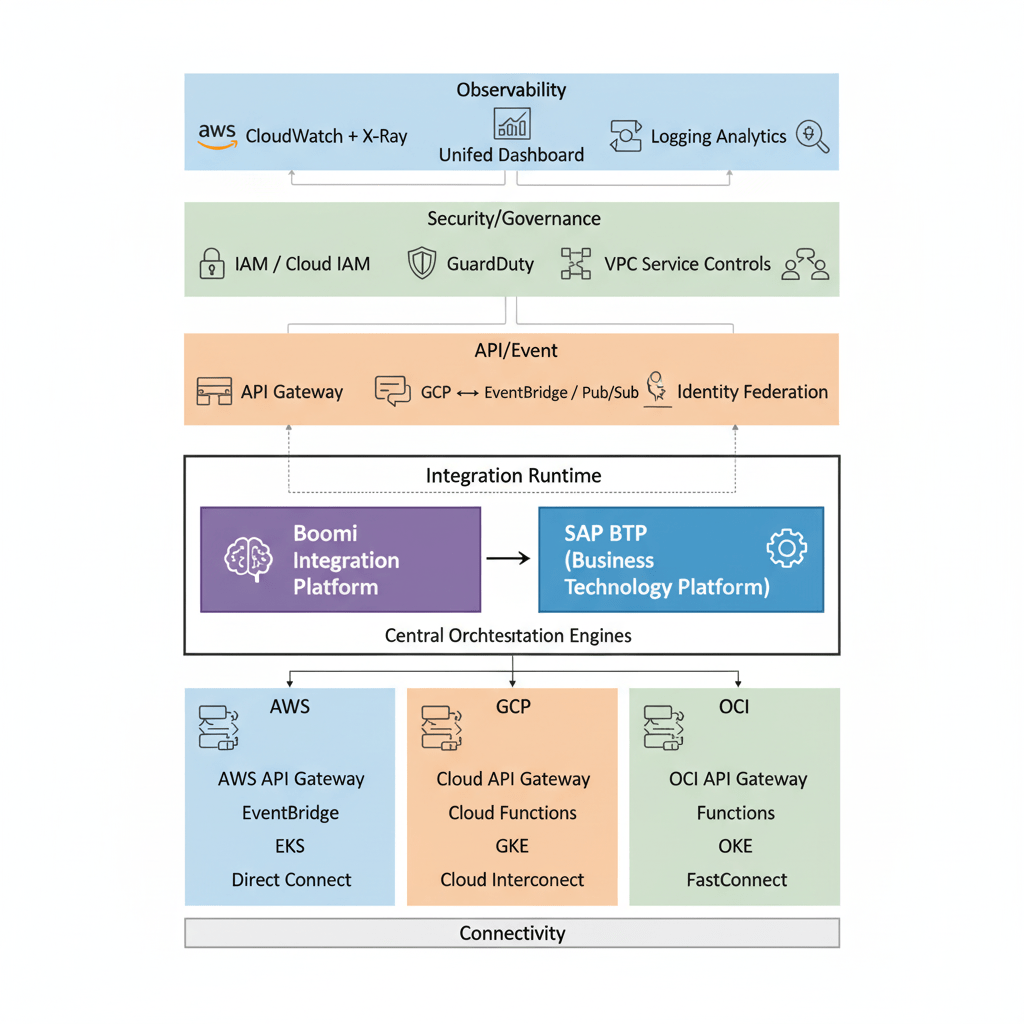
The proposed vendor-agnostic integration framework is composed of five interdependent layers, each serving a specific function in enabling secure, scalable, and interoperable integrations, as depicted in Figure 1. The Connectivity Layer establishes secure communication with SaaS, ERP, CRM, and partner systems by leveraging Boomi’s pre-built connectors and SAP’s packaged integration content. The Integration Runtime Layer executes integration flows through Boomi Atoms and Molecules or SAP BTP Cloud Integration runtimes. These can be deployed on AWS Elastic Kubernetes Service (EKS) and Lambda, Google Kubernetes Engine (GKE) and Cloud Run, or Oracle Kubernetes Engine (OKE) and Functions, providing full deployment flexibility. The API and Event Layer serves as a unified interface for exposing integration logic as APIs and event streams, utilizing technologies such as Apigee X, SAP API Management, or Boomi API Gateway. The Security and Governance Layer implements cross-cloud identity management, encryption, and compliance controls aligned with international standards, including GDPR, HIPAA, and SOC 2. Finally, the Observability Layer integrates performance monitoring and operational metrics into federated dashboards that connect with enterprise SIEM and SOAR systems, providing comprehensive visibility and governance across all integration environments.
The Figure 1 illustrates a unified multi-cloud integration architecture where AWS, GCP, and OCI are connected through central orchestration engines powered by Boomi and SAP BTP. Each cloud provides its own connectivity layer such as API Gateways, Functions, Kubernetes services, and dedicated network links while the integration runtime coordinates cross-cloud workflows and data flows. An API/Event layer enables standardized communication using Event Bridge, Pub/Sub, and identity federation, supported by a security and governance layer with IAM, Guard Duty, and VPC controls. At the top, observability tools like CloudWatch, X-Ray, and Logging Analytics deliver end-to-end monitoring through a unified dashboard. Overall, the architecture provides a secure, governed, and centrally managed framework for seamless multi-cloud interoperability.
3.3. Integration Patterns
The framework supports three primary integration patterns that enable enterprises to execute workflows effectively across multi-cloud environments. The Orchestration Pattern provides centralized management of complex workflows such as the Opportunity-to-Order process ensuring complete visibility and end-to-end traceability. The Choreography Pattern, in contrast, enables decentralized and event-driven interactions, where services communicate asynchronously. This model is well-suited for dynamic use cases such as partner onboarding and real-time supply chain updates. The Hybrid Pattern combines elements of orchestration and choreography, employing centralized control for mission-critical processes while maintaining event-driven flexibility for agile and real-time operations. Together, these patterns allow enterprises to tailor their integration approach based on workload type, business priority, and latency sensitivity.
3.4. Benefits of Vendor-Agnostic Approach
The adoption of a vendor-agnostic integration framework delivers several strategic benefits. By abstracting integration logic from cloud-specific services, enterprises can minimize vendor lock-in and gain the flexibility to shift workloads among AWS, GCP, and OCI based on cost optimization, performance, or strategic considerations. This approach also enhances resilience, as cross-cloud failover and disaster recovery can be implemented seamlessly, mitigating risks associated with provider outages. From a performance standpoint, deploying integration logic closer to data sources reduces latency and improves responsiveness. Furthermore, a vendor-agnostic model strengthens strategic agility, empowering enterprises to adopt best-of-breed services from each cloud provider without being constrained by proprietary limitations. In essence, the framework provides a foundation for interoperability, scalability, and continuous innovation enabling organizations to thrive in the evolving multi-cloud ecosystem.
4. Architecture and Flow Design
4.1. High-Level Architecture
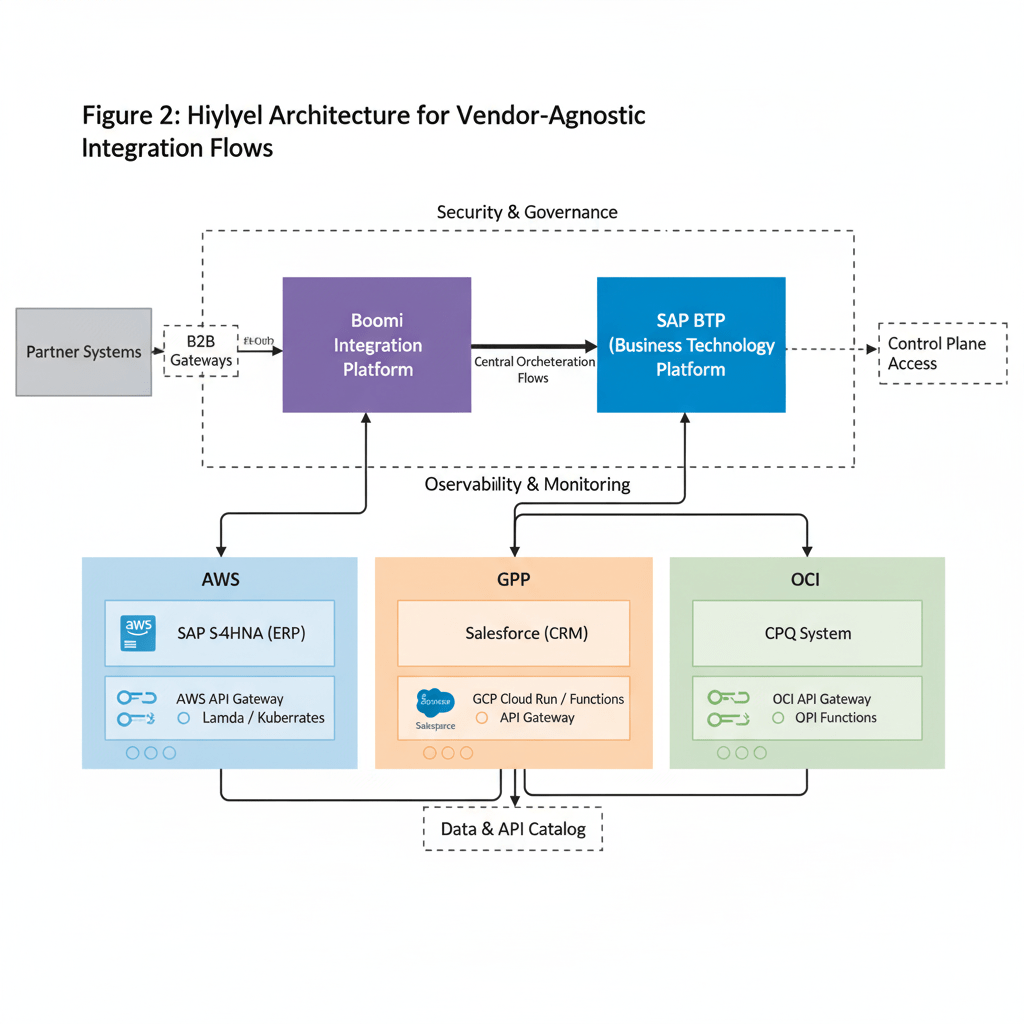
The proposed architecture positions Boomi and SAP BTP Integration Suite as complementary platforms that collaboratively orchestrate enterprise workflows across heterogeneous multi-cloud environments, including AWS, GCP, and OCI. At its foundation, the framework designs integration flows as loosely coupled APIs and event-driven services, deployed within cloud-native runtimes such as AWS Lambda, GCP Cloud Run, and OCI Functions. Boomi runtime deployments utilize Atoms for single-tenant and Molecules for clustered environments, both of which can be containerized and executed on Kubernetes clusters such as Amazon EKS, Google GKE, or Oracle OKE. These deployments also support serverless configurations, ensuring flexibility and portability across different cloud infrastructures. SAP BTP runtimes, on the other hand, extend pre-packaged SAP integration flows through APIs and Event Mesh, enabling seamless interoperability between SAP and non-SAP workloads. Cross-cloud API exposure is achieved through API gateways such as Apigee X, AWS API Gateway, SAP API Management, or Boomi API Gateway, ensuring consistent, secure access and unified governance across all integration endpoints [15], [16] .
This figure 2 represents an end-to-end multi-cloud integration landscape where Boomi and SAP BTP act as central orchestration engines connecting partner systems, ERP, CRM, and CPQ platforms across AWS, GCP, and OCI. Partner systems integrate through B2B gateways into Boomi, which coordinates flows with SAP BTP under a unified security and governance layer. Each cloud hosts key business systems SAP S/4HANA on AWS, Salesforce CRM on GCP, and the CPQ system on OCI exposed through their respective API Gateways, serverless functions, and Kubernetes environments. Observability and monitoring link all workloads back to the central platforms, while a shared Data & API Catalog ensures consistent discovery and management across the ecosystem. Overall, it illustrates a secure, governed, and centrally managed architecture enabling seamless interoperability between enterprise applications deployed across multiple clouds.
4.2. Flow Design for Key Enterprise Use Cases
4.2.1. Opportunity-to-Order (O2O) Workflow
The Opportunity-to-Order process typically spans multiple enterprise systems, including Salesforce CPQ, SAP S/4HANA, and external partner portals. In this workflow, Boomi manages the synchronization between Salesforce and SAP using pre-built CPQ connectors enhanced with custom logic for pricing and quotation handling. SAP BTP orchestrates downstream processes within SAP S/4HANA modules such as Sales and Distribution (SD) and Materials Management (MM) while also enabling real-time updates to fulfillment systems hosted on OCI. AWS Lambda supports elastic scaling for order enrichment tasks, and GCP BigQuery provides analytics capabilities by aggregating sales pipeline data for business insights [17].
4.2.2. ERP-to-CRM Synchronization
For seamless synchronization between ERP (SAP S/4HANA) and CRM (Salesforce, Dynamics 365) systems, real-time bidirectional data flow is crucial. Boomi’s low-code connectors facilitate data extraction and transformation between SAP IDocs and Salesforce objects, ensuring consistency and accuracy. SAP BTP complements these integrations through its Event Mesh, broadcasting updates to multiple subscribers such as analytics platforms on GCP or dashboards hosted on AWS. Security is enforced through OAuth 2.0 and mutual TLS (mTLS), while runtime credentials are managed via native identity services such as AWS IAM, GCP IAM, and OCI Identity Federation, maintaining secure and authenticated interactions across all environments.
4.2.3. B2B Partner Onboarding
In large-scale supply chains, partner onboarding such as for distributors like Ingram Micro or Arrow requires robust automation and secure transaction processing. Boomi’s B2B/EDI module manages partner-specific transaction mappings and supports data exchange through AS2 and SFTP protocols. SAP BTP validates partner data against SAP S/4HANA business rules and integrates it with procurement and supply chain systems for seamless transaction management. OCI provides resilient storage for archival and long-term retention of B2B transactions, while GCP Pub/Sub facilitates real-time event-driven notifications, ensuring synchronized communication across distributed partner ecosystems.
This Figure 3 shows an interconnected enterprise landscape where Salesforce (CRM) feeds data into Boomi, which orchestrates integrations toward SAP BTP and ultimately SAP S/4HANA ERP. From SAP S/4HANA, operational data flows into analytics platforms across AWS and GCP for data lake and business intelligence processing. In parallel, Boomi also supports B2B integrations with external partner systems through partner B2B gateways hosted on Oracle Cloud Infrastructure (OCI). Overall, the architecture demonstrates seamless CRM-to-ERP integration, multi-cloud analytics distribution, and secure partner connectivity through a unified integration platform.
4.3. Integration Flow Patterns
The framework supports multiple integration flow patterns to address diverse enterprise scenarios and performance requirements. Synchronous API flows enable real-time interactions such as retrieving order status from SAP S/4HANA via an API gateway ensuring immediate responses for user-facing applications. Asynchronous event flows leverage message queues and event meshes to enable decoupled, scalable communication between services, ideal for event-driven use cases. Batch processing flows are optimized for large-scale data synchronization and historical data migration, where processing latency is less critical. Finally, hybrid flows combine the best of both worlds real-time API interactions for critical requests and asynchronous updates for non-time-sensitive processes, such as real-time order creation followed by deferred fulfillment updates.
4.4. Comparative Role of Boomi vs. SAP BTP in Flow Design
Boomi and SAP BTP play distinct yet complementary roles in enterprise integration architecture. Boomi excels in broad connectivity, offering over 2,000 connectors that span SaaS, ERP, CRM, and legacy applications, whereas SAP BTP provides deeply optimized pre-built integration packages specifically designed for SAP applications such as S/4HANA, SuccessFactors, and Ariba. From a development perspective, Boomi’s low-code, drag-and-drop interface enables rapid prototyping and accelerates integration delivery, while SAP BTP delivers sophisticated process orchestration capabilities tailored for SAP-centric environments.
Boomi and SAP BTP play distinct yet complementary roles in enterprise integration flows as shown in the Table 1.
5. Security and Compliance Across Clouds
5.1. Importance of Security in Multi-Cloud Integration
In today’s enterprise ecosystem, APIs and integration flows represent one of the most critical attack surfaces, frequently targeted by malicious actors. Research indicates that more than 40% of data breaches stem from compromised APIs or integration points. In a vendor-agnostic, multi-cloud environment, this risk becomes even more pronounced because integration traffic often spans multiple clouds, networks, and identity domains. To effectively mitigate these risks, a secure integration framework must embed zero-trust principles, regulatory compliance, and end-to-end encryption directly into its design treating security as a foundational architectural element rather than a secondary consideration.
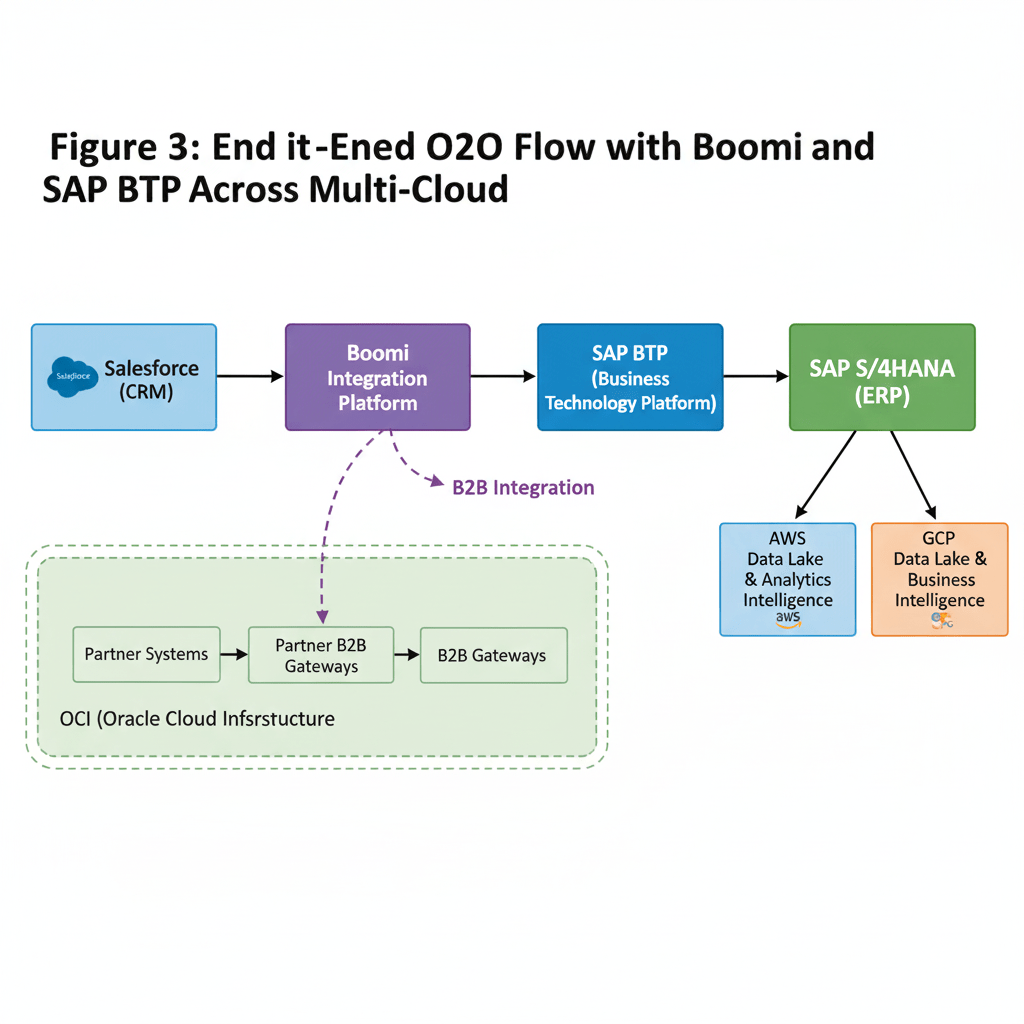
Table 1: Boomi and SAP BTP Strengths
Dimension | Boomi Strengths | SAP BTP Strengths |
Connectivity | 2,000+ connectors for SaaS, ERP, CRM, legacy apps | Pre-built SAP integration packages for S/4HANA, SuccessFactors, Ariba |
Flow Development | Low-code, drag-and-drop interface for rapid prototyping | Deep SAP process orchestration with event-driven integration |
Deployment Flexibility | Atoms/Molecules can run on AWS, GCP, OCI, or on-premises | Tight SAP ecosystem integration, optimized for SAP workloads |
B2B/EDI | Native support for AS2, X12, EDIFACT, and partner onboarding templates | Limited; typically extends via Boomi or third-party connectors |
API Management | Lightweight gateway for publishing APIs | Enterprise-grade API management with monetization, throttling, and governance |
Event-Driven | Integrates with cloud-native messaging (SQS, Pub/Sub, OCI Streaming) |
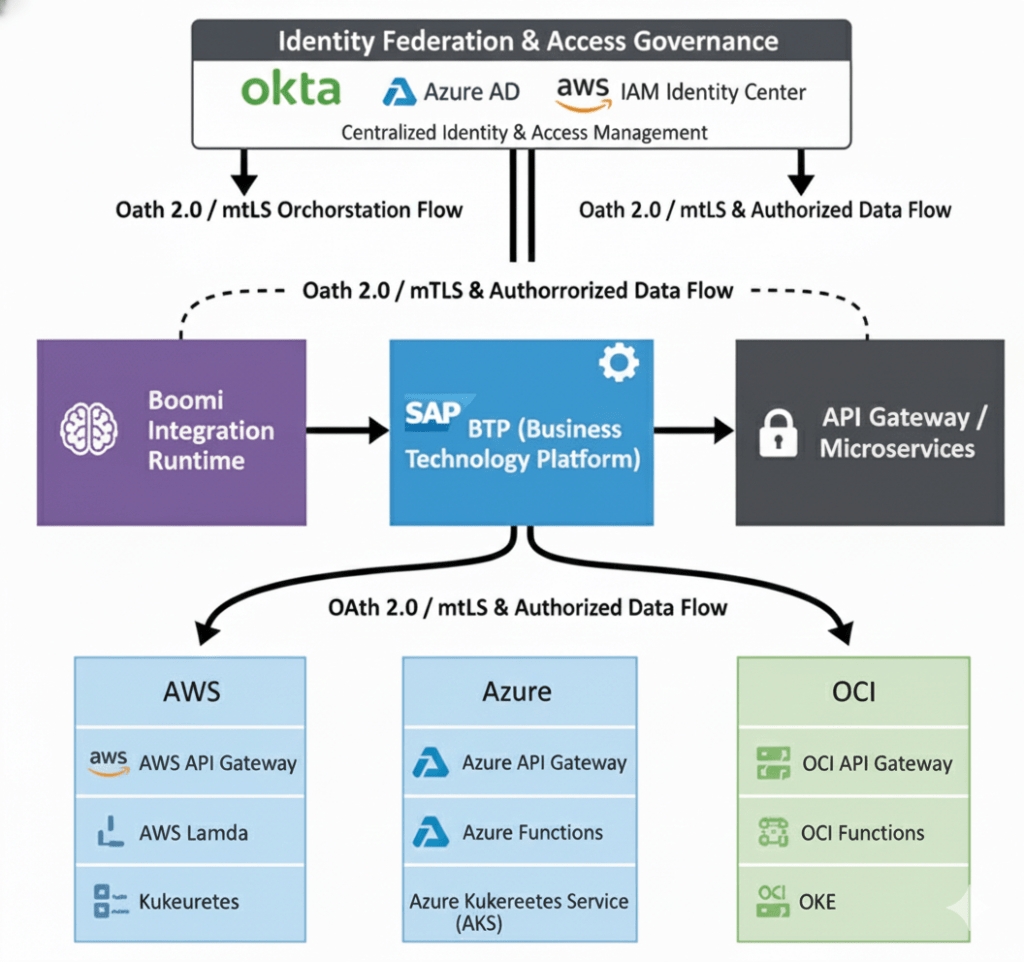
This Figure 4 illustrates a secure, identity-driven multi-cloud integration model where centralized identity providers such as Okta, Azure AD, and AWS IAM Identity Center enforce unified identity federation and access governance. Using OAuth 2.0 and mTLS, authorized data flows move between Boomi Integration Runtime, SAP BTP, and backend API gateways or microservices. From SAP BTP, secure integrations extend across AWS, GCP, and OCI using their respective cloud-native services API Gateway, Lambda, Kubernetes/EKS on AWS; Apigee, Cloud Functions, and GKE on GCP; and OCI API Gateway, Functions, and OKE on OCI. Overall, the architecture emphasizes end-to-end secure orchestration, centralized identity control, and consistent authorization across all clouds and integration platforms.
5.2. Zero-Trust Architecture (ZTA)
The zero-trust model operates on the principle that no user, device, or network should be inherently trusted, regardless of location or prior verification. Within integration environments, zero trust translates into identity-centric security controls, where every API call and message exchange is both authenticated and authorized using industry standards such as OAuth 2.0, OpenID Connect, or JWT. Micro-segmentation ensures that integration runtimes such as Boomi Atoms and SAP Cloud Integration tenants are securely isolated within private virtual networks (VPCs) across AWS, GCP, and OCI. Mutual TLS (mTLS) is used to enforce bidirectional authentication between Boomi runtimes [18], [19], SAP BTP, and external APIs. Additionally, just-in-time access mechanisms ensure that credentials and tokens are short-lived and dynamically managed through services such as AWS STS, GCP IAM, and OCI Identity Federation, thereby minimizing the risk of credential compromise [20].
5.3. Data Protection and Privacy
In regulated industries such as healthcare, finance, and the public sector, data protection and privacy are paramount in any integration strategy. All data must be encrypted at rest using AES-256 and in transit using TLS 1.3 to maintain confidentiality and integrity. Cloud-native key management services including AWS KMS, Google Cloud KMS, and OCI Vault enable centralized control over encryption key lifecycles. Furthermore, tokenization and data masking techniques safeguard sensitive information such as social security numbers, credit card details, and patient identifiers during data exchange. Data residency and sovereignty requirements are addressed through intelligent workload placement, where OCI may be chosen for jurisdictional control, AWS for global scalability, and GCP for analytics and AI-driven insights. This selective deployment strategy ensures that data governance and regulatory obligations are met without compromising performance or accessibility.
5.4. Regulatory Compliance Across Clouds
Because integration flows often span multiple geographies, they must adhere to differing regional and sector-specific compliance requirements. A vendor-agnostic framework must harmonize these obligations. For example, GDPR mandates rights such as data access and the right to be forgotten, which can be implemented through centralized API governance. HIPAA compliance
for U.S. healthcare requires encryption of protected health information, robust access logging, and detailed audit trails within Boomi and SAP BTP flows. In the financial sector, PCI DSS mandates tokenization of payment data and stringent logging of transaction flows. Government and defense use cases require compliance with FedRAMP and SOC 2 standards, ensuring that Boomi runtimes and SAP BTP tenants align with federal security baselines. Both Boomi and SAP BTP offer pre-certified compliance templates, while AWS, GCP, and OCI provide cloud-native attestations such as ISO 27001 and SOC 2 Type II, enabling enterprises to inherit compliance assurances from their underlying infrastructure
5.5. Governance and Auditability
Strong governance mechanisms are essential for ensuring that security and compliance policies are not only enforced but also continuously monitored. Centralized API governance frameworks establish consistent policy controls for rate limiting, throttling, and SLA enforcement across multiple clouds. Federated observability powered by tools such as Splunk, Datadog, AWS CloudWatch, GCP Operations, or OCI Monitoring provides unified, real-time visibility into compliance posture and operational health. Detailed audit trails record and time-stamp every integration transaction, supporting traceability for internal and external audits. Additionally, adopting policy-as-code principles enables organizations to codify security and compliance standards within Infrastructure-as-Code (IaC) templates, ensuring consistent implementation and reducing manual errors across distributed environments.
6. Performance, Scalability, and Observability
6.1. Importance of Performance in Multi-Cloud Integration
Enterprises require integration flows to deliver low latency, high throughput, and predictable reliability. For critical workflows such as Opportunity-to-Order (O2O) or ERP-to-CRM synchronization, even minor delays can result in revenue loss, compliance violations, or negative customer experiences. In a vendor-agnostic, multi-cloud environment, performance optimization becomes more complex, requiring careful tuning of network paths, runtime deployments, and workload distribution strategies [21].
This Figure 5 shows how Boomi Molecules achieve horizontal scaling by distributing workloads across multiple cloud platforms AWS, GCP and OCI. Each cloud provides both serverless and Kubernetes-based execution environments, such as AWS Lambda and EKS, GCP Cloud Functions and GKE, and OCI Functions and OKE. By leveraging these cloud-native scaling mechanisms, Boomi services can run in a geo-distributed and highly available architecture, ensuring resilient performance and continuity across regions and cloud providers.
6.2. Scalability Models
Multi-cloud integrations must be capable of dynamically scaling to accommodate fluctuating business demands.
Four key scalability models are commonly adopted. Horizontal scaling involves scaling Boomi Molecules and SAP BTP tenants across Kubernetes clusters such as Amazon EKS, Google GKE, Azure GKE or Oracle OKE to
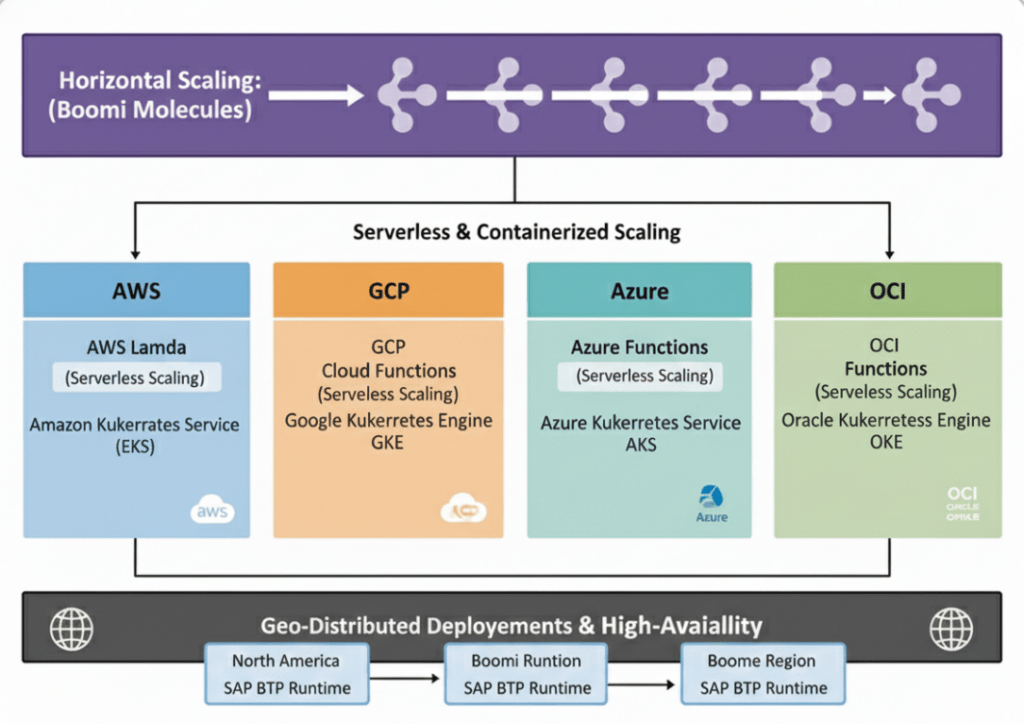
handle increased transaction volumes. Vertical scaling supports resource-intensive processes such as large EDI file transformations by provisioning higher-capacity instances in OCI Compute or AWS EC2. Elastic scaling leverages serverless compute, including AWS Lambda, GCP Cloud Functions, and OCI Functions, to automatically adjust workloads in response to traffic spikes, thereby reducing costs for bursty processes. Finally, geo-distributed scaling reduces latency by deploying runtimes closer to users or enterprise systems for instance, running Boomi runtimes in AWS Virginia for Salesforce workloads while deploying another runtime in OCI Frankfurt for SAP S/4HANA.
6.3. Performance Optimization Techniques
Ensuring optimal throughput and minimal latency requires a set of complementary performance techniques. Data caching improves response times by storing frequently accessed reference data, such as product catalogs and price lists, in caching solutions like AWS ElastiCache, GCP Memory store, or OCI Redis. Payload optimization reduces cross-cloud data transfer overhead by performing transformations close to the data source for example, running SAP BTP runtimes adjacent to SAP S/4HANA workloads. Batch versus real-time tuning differentiates between large-scale data migrations, which are more efficient as batch processes, and transactional updates, which benefit from event-driven streams for responsiveness. Additionally, network acceleration minimizes latency and jitter through private interconnects such as AWS Direct Connect, Google Cloud Interconnect, and OCI Fast Connect.
6.4. Observability in Multi-Cloud Integration
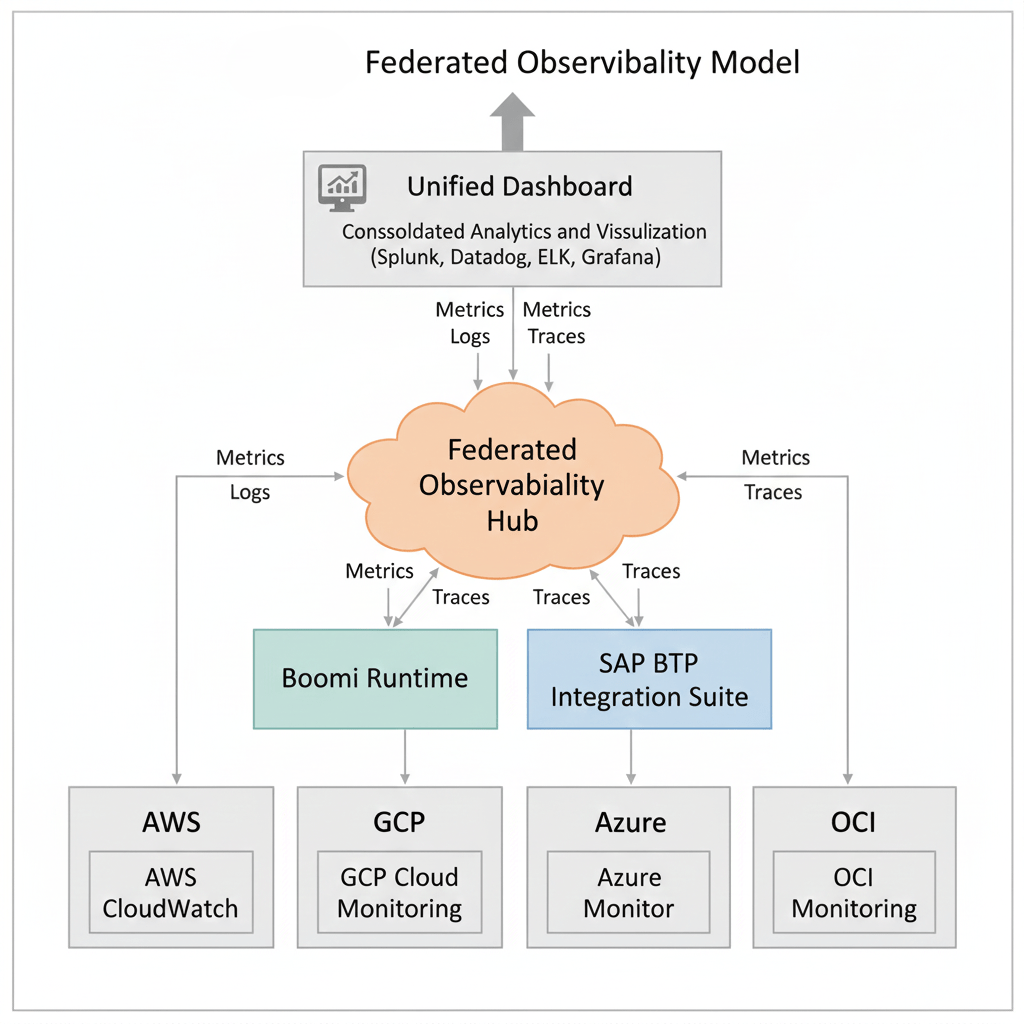
Observability goes beyond simple monitoring, enabling enterprises to predict failures, optimize flows, and ensure compliance across distributed environments. A vendor-agnostic integration framework requires federated observability that spans Boomi, SAP BTP, and the underlying cloud providers. Core components include metrics monitoring, where throughput, latency, and error rates are tracked using AWS CloudWatch, GCP Cloud Monitoring, and OCI Monitoring, unified within centralized dashboards like Splunk or Datadog. Distributed tracing powered by Open Telemetry enables root-cause analysis across Boomi Atoms and SAP BTP flows in multi-cloud environments. Log aggregation consolidates integration and API logs into platforms such as Splunk or ELK pipelines, ensuring holistic visibility. Finally, AI-driven anomaly detection tools, such as GCP Vertex AI and AWS Lookout, predict unusual traffic patterns or potential integration failures before they impact business operations.
The Figure 6 shows a unified observability architecture where logs, metrics, and traces from Boomi integrations, SAP BTP events, and multi-cloud telemetry from AWS, GCP, Azure and OCI feed into a centralized observability platform such as Elastic Stack, Grafana, or Splunk. By aggregating these insights into a single pane of glass dashboard, the system enables real-time monitoring, cross-platform visibility, and AI-driven operational insights across all integration and cloud environments.
6.5. Benchmarking Across Clouds
To validate scalability and reliability in a vendor-agnostic model, enterprises must conduct performance benchmarks across AWS, GCP, and OCI. Benchmarking involves measuring latency, ensuring API response times remain below 200 milliseconds for real-time ERP queries; throughput, with Boomi Molecule clusters sustaining over 5,000 transactions per minute; elasticity, where serverless
runtimes seamlessly scale from 10 to 10,000 requests without downtime; and error recovery, which ensures automatic retries and failover within 30 seconds during regional outages.
6.6. Benefits of Performance-Aware Vendor-Agnostic Integration
Embedding scalability and observability into integration design yields significant enterprise benefits. High availability is achieved through seamless failover between AWS, GCP, and OCI regions. Operational efficiency improves as workloads are dynamically optimized, reducing infrastructure costs. Predictive reliability is enhanced through AI-driven observability, which prevents outages before they occur. Finally, business agility is maximized, as mission-critical workflows such as O2O remain resilient and responsive, even during peak load conditions.
7. Case Studies and Comparative Analysis
7.1. Case Study 1: Opportunity-to-Order (O2O) Migration
A global cybersecurity enterprise executed a large-scale migration of its Opportunity-to-Order (O2O) workflows [18] from legacy Oracle SOA middleware to a vendor-agnostic, multi-cloud architecture built on Boomi and SAP BTP. The primary challenge was that legacy middleware introduced significant latency, with Salesforce CPQ-to-SAP order flows exceeding two seconds, and lacked flexibility during merger and acquisition-driven divestitures. The adopted solution positioned Boomi as the primary integration engine for Salesforce CPQ to SAP S/4HANA interactions, while SAP BTP orchestrated downstream SAP modules. Runtime scaling was distributed across AWS for Salesforce workloads, GCP for analytics, and OCI for SAP. The migration achieved an outcome where API response times were reduced to under 250 milliseconds, elastic scaling absorbed seasonal spikes such as fiscal year-end activity, and compliance was maintained for both GDPR and SOX audit requirements.
7.2. Case Study 2: ERP-to-CRM Real-Time Synchronization
A healthcare provider required real-time synchronization of patient and billing data between SAP S/4HANA as the ERP backbone and Salesforce Health Cloud as the CRM system. Data silos in the legacy model created inconsistencies that not only jeopardized HIPAA compliance but also impaired billing accuracy. The solution involved Boomi managing bidirectional mappings between SAP IDocs and Salesforce objects, while SAP BTP’s Event Mesh broadcasted updates to downstream analytics hosted in GCP. The result was a dramatic reduction in synchronization latency, decreasing from several hours to less than one minute, thereby ensuring accurate real-time updates and full compliance with HIPAA logging and auditability requirements.
7.3. Case Study 3: B2B Partner Onboarding in Supply Chain
A high-tech manufacturer faced challenges in onboarding new global distribution partners such as Ingram Micro, Arrow, and Carahsoft. Traditional onboarding with EDI/X12 transaction support required weeks of custom development, delaying supply chain responsiveness. The solution utilized Boomi’s B2B/EDI accelerators, which streamlined document mapping and provided reusable partner onboarding templates. SAP BTP validated purchase orders against SAP S/4HANA business rules, while GCP Pub/Sub handled real-time partner notifications and OCI Object Storage provided resilient archiving. The outcome was a 70% reduction in onboarding time, a doubling of transaction throughput, and significant improvements in supply chain visibility through unified dashboards.
The Figure 7 depicts an end-to-end integration flow where partner systems send data through the Boomi Integration Platform, which acts as both an EDI and API gateway. Boomi routes and processes the data into SAP BTP for orchestration before it reaches the SAP S/4HANA ERP system. Along the way, GCP Cloud Notifications can be triggered based on integration events, and once processed in S/4HANA, archival data is securely stored in OCI Object Storage. Overall, the architecture demonstrates a streamlined multi-cloud integration pipeline with event notifications and cloud-based archival support.
7.4. Comparative Cloud Capabilities for Integration
To further contextualize these case studies, a comparative analysis of AWS, GCP, and OCI highlights each provider’s strengths in vendor-agnostic integration as shown table 2 below.
8. Challenges and Lessons Learned
While vendor-agnostic integration offers crucial flexibility and portability, its implementation introduces significant architectural and operational complexity. A key challenge is the integration complexity itself; designing flows across Boomi, SAP BTP, and three distinct cloud environments (AWS, GCP, OCI) requires deep, fragmented expertise across diverse runtimes and APIs. This complexity is amplified by the inherent conflict between pure vendor neutrality and the benefits of deep cloud-native optimization were using a provider’s native services (like AWS Step Functions) might offer better performance than a neutral, cross-provider component. To counter these issues, enterprises must establish a centralized Integration Competency Center (ICC) to enforce standards and adopt a hybrid strategy that selectively leverages cloud-native services for mission-critical scenarios while maintaining neutrality for general portability.
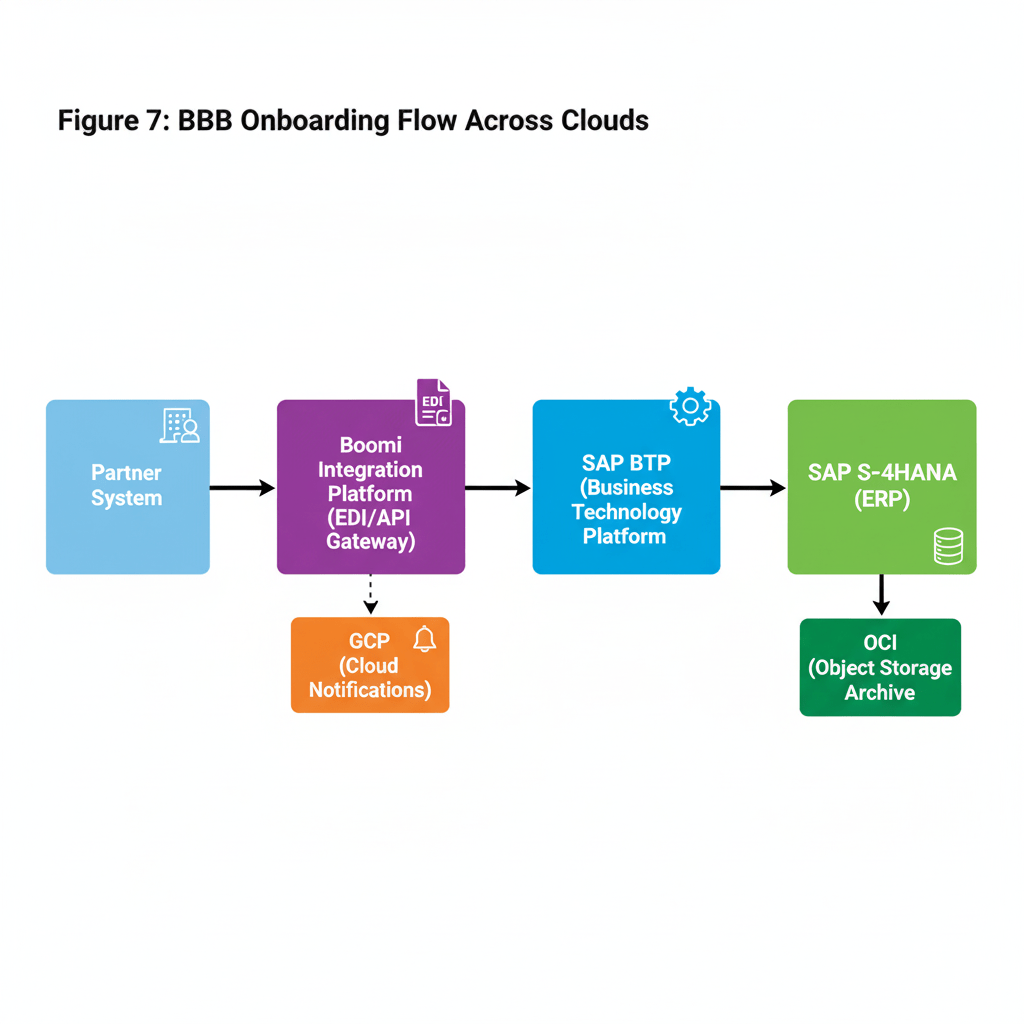
Table 2: Cloud Capability Dimensions
Capability Dimension | AWS | GCP | OCI |
Strength | Elastic compute, serverless (Lambda), mature security (IAM, PrivateLink) | AI/ML (Vertex AI), API Management (Apigee X), BigQuery [22], [23] | Enterprise ERP workloads, cost-effective high-performance compute |
Networking | VPC Peering, Direct Connect | Cloud Interconnect, Private Service Connect | Fast Connect, low-latency interconnects |
Serverless/Runtime | Lambda, ECS, EKS for Boomi runtimes | Cloud Run, GKE, Functions for event-driven | Functions, OKE for SAP workloads |
Data/Analytics | Redshift, Kinesis | BigQuery, Pub/Sub, Looker | Autonomous Database, Data Flow |
Compliance Certifications | FedRAMP, HIPAA, SOC 2, PCI DSS | GDPR, HIPAA, ISO 27001, AI ethics frameworks | GDPR, SOX, PCI DSS, data sovereignty focus |
Best-Fit Use Cases | Real-time ERP-CRM sync, scalable O2O flows | Analytics-driven workflows, partner notifications | SAP-heavy workloads, B2B/EDI flows, regulated industries |
Operational execution in this model also presents obstacles related to latency and governance. Cross-cloud traffic, even with dedicated interconnects, introduces performance overhead, particularly for synchronous ERP-to-CRM workflows. Simultaneously, enforcing zero-trust security and maintaining compliance audit trails across diverse IAM models and monitoring tools introduces substantial governance overhead. To mitigate these performance and security risks, teams must design latency-aware architectures by geo-distributing runtimes and prioritizing asynchronous flows, while standardizing on policy-as-code (using tools like Terraform and OPA) and implementing federated observability dashboards for unified visibility. Finally, managing cost optimization trade-offs and organizational change is paramount. The risk of cost inefficiencies from duplicate resources must be addressed by embedding FinOps practices and strategic workload placement, while the shift to multi-cloud operating models necessitates early investment in cross-training, certifications, and governance playbooks to ensure seamless adoption by integration teams. As shown in the Table 3, key lesson learned.
Table 3: Key Challenges and Lessons Learned
Challenge | Lesson Learned |
Integration Complexity | Establish a centralized Integration Competency Center (ICC). |
Vendor Neutrality vs. Depth | Hybrid strategy: balance portability with cloud-native optimizations. |
Latency & Network Overheads | Deploy runtimes closer to data sources; adopt async flows. |
Security & Governance | Standardize policy-as-code and federated observability. |
Cost Optimization | Apply FinOps, auto-scaling, and workload placement strategies. |
Organizational Change | Provide training, certifications, and governance playbooks. |
9. Future Directions
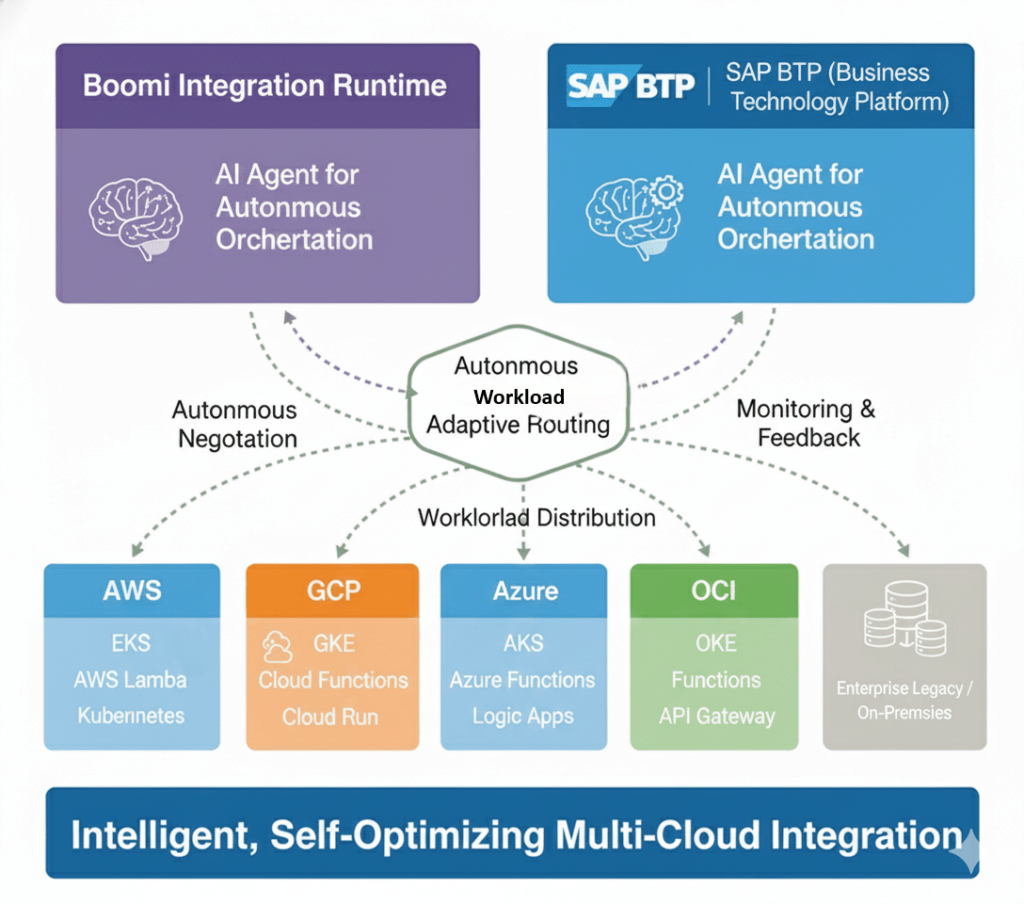
The future of vendor-agnostic integration is poised to be transformed by the convergence of artificial intelligence (AI), automation, multi-agent orchestration, federated observability, and quantum-inspired security. Emerging platforms such as Boomi and SAP BTP are increasingly embedding machine learning capabilities that can recommend mappings, auto-generate integration flows, and predict performance bottlenecks. These advancements are paving the way for self-healing integration pipelines that autonomously detect anomalies, reroute traffic, and optimize performance without human intervention. The evolution toward multi-agent orchestration will further enable autonomous, agent-driven runtimes where intelligent agents monitor health, performance, and compliance, negotiate workloads across AWS, GCP, Azure, and OCI, and dynamically collaborate to form adaptive, context-aware integration pipelines. Complementing this evolution, federated observability augmented by AI insights will unify telemetry across multi-cloud ecosystems, enabling predictive maintenance, automated compliance monitoring, and proactive root-cause analysis. As quantum computing advances, enterprises will also adopt quantum-resistant encryption and AI-assisted key rotation to secure API payloads and enhance resilience. In parallel, generative AI particularly through large language models (LLMs) will revolutionize the developer experience, enabling natural language-driven integration design, AI copilots for real-time recommendations, and automated documentation for governance and audit readiness. Collectively, these innovations will redefine integration as a self-optimizing digital nervous system capable of autonomous adaptation, regulatory alignment, and continuous improvement ushering in an era of intelligent, future-proof architectures that seamlessly operate across AI- and quantum-enabled multi-cloud environments.
This Figure 8 illustrates an intelligent, self-optimizing multi-cloud integration model where AI agents within Boomi Integration Runtime and SAP BTP autonomously orchestrate workloads across AWS, GCP, Azure, and OCI. These AI agents perform autonomous negotiation, adaptive routing, and continuous monitoring to decide the best cloud environment such as AWS EKS/Lambda, GCP GKE/Cloud Functions, or OCI OKE/Functions for executing integration tasks. Through real-time feedback loops, the system dynamically balances workloads, improves performance, and optimizes resource utilization across clouds.
10. Conclusion
The adoption of multi-cloud strategies has fundamentally redefined enterprise integration, compelling organizations to move away from vendor-proprietary middleware toward vendor-agnostic, cloud-portable frameworks. This paper has successfully demonstrated how the synergistic deployment of Boomi and SAP BTP Integration Suite across AWS, GCP, and OCI can deliver the scalable, secure, and interoperable flows necessary for modern digital transformation. The proposed architectural framework, detailed across five critical layers Connectivity, Integration Runtime, API/Event Management, Security and Governance, and Observability provides a practical blueprint for navigating
heterogeneous multi-cloud environments. Through practical design examples such as the Opportunity-to-Order (O2O) workflow, ERP-to-CRM synchronization, and B2B partner onboarding, we validated that vendor neutrality is both technically feasible and strategically advantageous. Key contributions include the development of a unified reference architecture that abstracts integration logic from underlying cloud dependencies, and the identification of practical integration patterns orchestration, choreography, and hybrid approaches that balance centralized control with operational agility. Furthermore, the research provided a comprehensive view of security, compliance, and zero-trust enforcement strategies for multi-cloud integrations, supported by a comparative analysis of AWS, GCP, and OCI capabilities, and emphasized the value of federated monitoring for performance and observability. While the study acknowledged challenges related to architectural complexity, governance overhead, and cost optimization trade-offs, it suggested mitigation through centralized governance, policy-as-code, FinOps, and proactive change management. Looking forward, the future of enterprise integration will be shaped by innovations in AI-driven automation, multi-agent orchestration, and quantum-inspired security, transforming integration into a self-optimizing and intelligent ecosystem. Ultimately, this paper positions vendor-agnostic integration not merely as a technical approach, but as a strategic enabler of enterprise resilience and agility in a complex multi-cloud era.
- Gartner, “Integration platform as a service (iPaaS) market reviews and overview,” 2025. Accessed: Sep. 27, 2025. [Online]. Available: https://www.gartner.com/reviews/market/integration-platform-as-a-service
- R. Johnson, Boomi Integration Architecture and Solutions: Definitive Reference for Developers and Engineers. HiTeX Press, 2025. [Online]. Available: https://books.google.com/books?hl=en&lr=&id=ho5mEQAAQBAJ&oi=fnd&pg=PT8&dq=boomi+integration&ots=72CcbsI7lN&sig=5xTrsJooOxskYrSzxHbiTsNigls#v=onepage&q=boomi%20integration&f=false
- S. Annanki, “Seamless integration with SAP Business Technology Platform (BTP),” International Journal of Computer Technology and Electronics Communication, vol. 6, no. 5, pp. 7573–7580, 2023. [Online]. Available: https://ijctece.com/index.php/IJCTEC/article/view/156
- SAP, “Feature scope description for SAP Integration Suite,” Sep. 2025. Accessed: Sep. 27, 2025. [Online]. Available: https://help.sap.com/doc/e50e61e7b66c4b60ae5e88c00c01486a/CLOUD/en-US/FSD_IntegrationSuite.pdf
- T. Sankar, “Seamless integration using SAP to unify multi-cloud and hybrid application,” International Journal of Engineering Technology Research & Management, vol. 8, no. 3, pp. 236–246, 2024. doi: 10.5281/zenodo.15760884
- SAP, “SAP Cloud Integration product page (Help Portal),” 2025. Accessed: Sep. 27, 2025. [Online]. Available: https://help.sap.com/docs/cloud-integration/sap-cloud-integration/sap-cloud-integration
- Amazon Web Services, “AWS Direct Connect user guide,” 2025. Accessed: Sep. 27, 2025. [Online]. Available: https://docs.aws.amazon.com/directconnect/latest/UserGuide/Welcome.html
- Google Cloud, “Cloud Interconnect concepts and overview,” 2025. Accessed: Sep. 27, 2025. [Online]. Available: https://cloud.google.com/network-connectivity/docs/interconnect/concepts/overview
- Google Cloud, “Apigee release notes,” 2025. Accessed: Sep. 27, 2025. [Online]. Available: https://cloud.google.com/apigee/docs/release-notes
- Oracle, “Oracle Cloud Infrastructure FastConnect overview,” 2025. Accessed: Sep. 27, 2025. [Online]. Available: https://docs.oracle.com/en-us/iaas/Content/Network/Concepts/fastconnect.htm
- Oracle, “OCI Streaming concepts and getting started,” 2025. Accessed: Sep. 27, 2025. [Online]. Available: https://docs.public.content.oci.oraclecloud.com/en-us/iaas/Content/Streaming/Concepts/streaminggettingstarted.htm
- J., “Seamless integration using SAP to unify multi-cloud and hybrid applications,” Academia.edu. doi: 10.5281/zenodo.15760884
- MSRCosmos, “Overcoming SAP integration challenges in multi-cloud environments,” MSRCosmos blog. [Online]. Available: https://www.msrcosmos.com/blog/overcoming-sap-integration-challenges-in-multi-cloud-environments/
- “Seamless integration using SAP to unify multi-cloud and hybrid applications,” ResearchGate / Academia. [Online]. Available: https://www.researchgate.net/publication/393254159_SEAMLESS_INTEGRATION_USING_SAP_TO_UNIFY_MULTI-CLOUD_AND_HYBRID_APPLICATION.
- SAP, “The enterprise integration suite for hybrid and heterogenous environments,” SAP, [PDF]. [Online]. Available: https://assets.dm.ux.sap.com/webinars/2021-12-31-sap-btp-customer-value-network-global/pdfs/sap_integration_suite_sap_btp_series_202209.pdf
- “Multi-cloud integration strategies for SAP,” International Research Journal of Modernization in Engineering, Technology and Science (IRJMETS), Mar. 2025. doi: 10.56726/IRJMETS68646
- P. Venkiteela, “Modernizing opportunity-to-order workflows through SAP BTP integration architecture,” International Journal of Applied Management, 2025. [Online]. Available: https://ijamjournal.org/ijam/publication/index.php/ijam/article/view/141
- Amazon Web Services, “Boomi Integration Platform as a Service (iPaaS) – AWS,” AWS Marketplace. [Online]. Available: https://aws.amazon.com/marketplace/pp/prodview-iwafwndgdmpjq
- NeoSAlpha, “Top 10 reasons Boomi iPaaS is the preferred integration,” NeoSAlpha, Feb. 2025. [Online]. Available: https://neosalpha.com/top-10-reasons-boomi-ipaas-is-best-solution-for-enterprises/
- “Enhancing performance of serverless architectures in multi-cloud environments,” IRE Journals. [Online]. Available: https://www.irejournals.com/formatedpaper/1709488.pdf
- MSRCosmos, “Overcoming SAP integration challenges in multi-cloud environments,” MSRCosmos blog, Jul. 29, 2025. [Online]. Available: https://www.msrcosmos.com/blog/overcoming-sap-integration-challenges-in-multi-cloud-environments/
- P. Venkiteela, “Strategic API modernization using Apigee X for enterprise transformation,” Journal of Information Systems Engineering and Management, 2024. [Online]. Available: https://www.jisem-journal.com/index.php/journal/article/view/13168
- P. Venkiteela, “Comparative analysis of leading API management platforms for enterprise API modernization,” International Journal of Computer Applications, 2025. doi: 10.5120/ijca2025925924