
A Study on the Hierarchical Expansion of the Triangle Concept in Mathematics Education

(This article belongs to the Section Education and Educational Research (EER))
Export Citations
Cite
Kang, H. and Jekal, E. (2026). A Study on the Hierarchical Expansion of the Triangle Concept in Mathematics Education. Journal of Engineering Research and Sciences, 5(5), 12–18. https://doi.org/10.55708/js0505002
Hyeseong Kang and Eunsung Jekal. "A Study on the Hierarchical Expansion of the Triangle Concept in Mathematics Education." Journal of Engineering Research and Sciences 5, no. 5 (May 2026): 12–18. https://doi.org/10.55708/js0505002
H. Kang and E. Jekal, "A Study on the Hierarchical Expansion of the Triangle Concept in Mathematics Education," Journal of Engineering Research and Sciences, vol. 5, no. 5, pp. 12–18, May. 2026, doi: 10.55708/js0505002.
This study aims to analyze the hierarchical development of the triangle concept across elementary and secondary mathematics curricula through the theoretical lens of Van Hiele’s geometric thinking levels. The triangle is introduced in elementary school as a visual and perceptual object, reinterpreted in middle school as a structure involving relationships among sides and angles, and finally abstracted in high school into the forms of trigonometric ratios, trigonometric functions, and trigonometric inequalities. The study argues that this repeated appearance of the triangle throughout the curriculum does not represent mere content repetition, but rather reflects qualitative shifts in students’ modes of geometric reasoning. By mapping curriculum achievement standards related to triangles onto Van Hiele’s levels from visualization to formal deduction, this research demonstrates how the concept of the triangle evolves from a concrete figure to a formal mathematical structure. The findings provide theoretical support for curriculum coherence and suggest instructional strategies that promote meaningful conceptual continuity.
1. Introduction
The triangle is one of the most fundamental and enduring concepts in school mathematics. From the early grades of elementary school to advanced courses in high school, it repeatedly appears in various forms and contexts. In elementary mathematics, triangles are introduced primarily as visual geometric figures. In middle school, they become objects of relational reasoning through topics such as the Pythagorean theorem and similarity. In high school, triangles serve as the conceptual foundation for trigonometric ratios, trigonometric functions, and related inequalities [1-4].
Despite this apparent continuity, many students experience the transition from geometry to trigonometry as abrupt and disconnected. In particular, when learning trigonometric functions, students often perceive that the triangle concept has disappeared and been replaced by an entirely new algebraic framework. This suggests that the hierarchical structure of the curriculum is not always sufficiently recognized or emphasized in classroom instruction [5-7].
The purpose of this study is to examine how the triangle concept expands and transforms throughout the mathematics curriculum, and to interpret this process using Van Hiele’s theory of geometric thinking levels. By clarifying the cognitive transitions embedded in the curriculum, this research seeks to provide a coherent theoretical framework for understanding the development of geometric reasoning from elementary to secondary education [8-10].
Unlike prior studies that apply Van Hiele theory to general geometric learning, this study focuses specifically on the longitudinal expansion of the triangle concept across grade levels. By explicitly linking triangle-based reasoning to the development of trigonometric concepts, this study provides a unified cognitive framework connecting geometry and trigonometry.
2. Theoretical Background
While previous studies have examined geometric thinking and trigonometric learning separately, relatively few have explored the conceptual continuity between these domains. This gap highlights the importance of a unified framework such as the one proposed in this study.
2.1. Research on Van Hiele Theory and Geometric Thinking
Van Hiele’s theory has been one of the most influential frameworks for understanding how students develop geometric reasoning. Numerous international studies have reported that students do not naturally progress to higher levels of reasoning simply through exposure to advanced content. Instead, movement from visualization to analysis and deduction requires carefully sequenced instructional experiences [11].
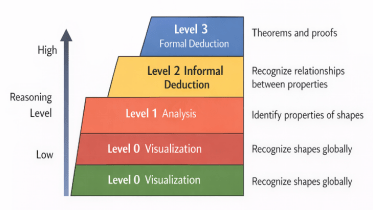
Research based on this theory has consistently shown three major findings. First, students at lower levels tend to rely on visual prototypes when identifying geometric figures. Second, the ability to list properties of shapes does not automatically imply the ability to reason about relationships among those properties. Third, formal deductive reasoning becomes meaningful only after students have accumulated sufficient experiences at the informal deduction level [12-14].
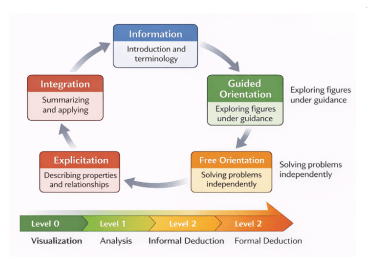
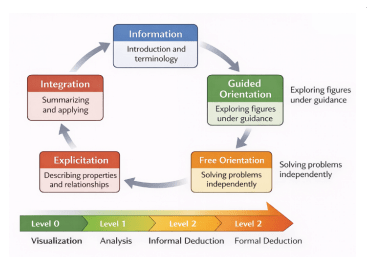
Figure 2 illustrates the typical instructional phases proposed within the Van Hiele framework: information, guided orientation, explication, free orientation, and integration. These phases explain why simple lecture-based instruction is often insufficient for deep geometric understanding. The diagram emphasizes that conceptual development requires active exploration and structure reflection.
2.2. Studies on the Development of the Triangle Concept
The triangle has long been used as a representative object in research on geometric concept formation. International studies on elementary students indicate that many learners recognize only prototypical triangles, such as equilateral triangles with a horizontal base. When triangles are rotated or presented in non-standard proportions, a significant number of students fail to classify them correctly [15-16].
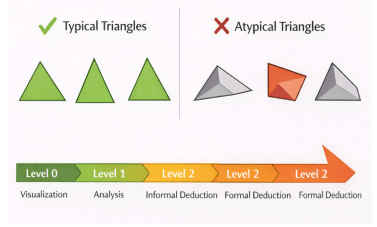
Further research on middle school students demonstrates that even when learners can state definitions of triangles, they often treat these definitions as isolated facts rather than as logically connected systems. Investigations of classroom discourse reveal that students frequently memorize classification rules without understanding hierarchical relations among types of triangles.
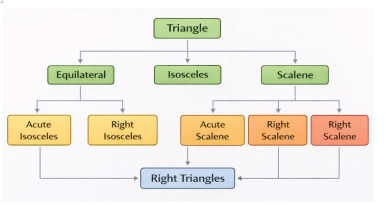
Figure 4 presents a conceptual map of the relationships among scalene, isosceles, equilateral, acute, right, and obtuse triangles. This representation is important because many learners struggle to understand that a single triangle can belong to multiple categories simultaneously. Studies emphasize that making such relationships explicit is essential for movement from Van Hiele Level 1 to Level 2.
2.3. Research on Learning Trigonometry
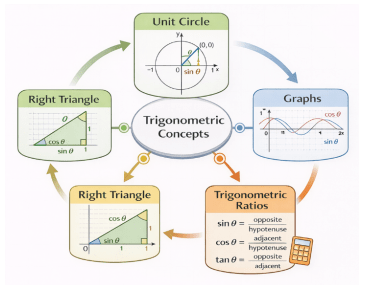
Learning trigonometry has been identified as one of the most challenging topics in secondary mathematics worldwide. Research reports that students often perceive trigonometry as an algebraic procedure disconnected from prior geometric experiences. Common difficulties include understanding angle measure, interpreting ratios as functions, and connecting right triangle definitions with unit circle representations.
Educational studies highlight the importance of coordinating multiple representations: right triangles, coordinate graphs, unit circles, and algebraic expressions. Students who experience trigonometric concepts only through symbolic manipulation tend to develop fragile and procedural knowledge. Conversely, instruction that explicitly links triangles to circular and functional models leads to deeper conceptual understanding.
2.4. Implications for Curriculum Coherence
The three research traditions described above converge on a common conclusion: meaningful learning in geometry and trigonometry requires carefully structured conceptual progression. The triangle serves as a central organizing idea that connects these domains. Therefore, analyzing how the triangle concept evolves across grade levels provides a powerful lens for examining overall curriculum coherence.
3. Research Methodology
This study adopts a theoretical and curriculum-analytic approach. The analysis focuses on mathematics curriculum standards across elementary, middle, and high school levels. Triangle-related content was identified and systematically examined.
To analyze the hierarchical development of the triangle concept, curriculum elements were mapped onto Van Hiele’s levels of geometric thinking [17-19].
The mapping was based on:
(1) the type of reasoning required,
(2) the use of definitions and properties,
(3) the level of abstraction.
The analysis was conducted in three stages:
(1) identification of relevant content,
(2) classification according to cognitive demand,
(3) alignment with Van Hiele levels.
2. The Triangle Concept in Elementary Mathematics
2.1. Visualization Level (Level 0)
In the early grades, triangles are introduced as shapes with “three corners” or “three sides.” Recognition is based largely on prototypical images such as equilateral triangles. Students at this level often struggle to identify triangles that are rotated, elongated, or otherwise non-standard. Their understanding is perceptual rather than definitional, which is characteristic of Van Hiele’s visualization level.
2.2. Analysis Level (Level 1)
In upper elementary grades, students learn to classify triangles according to side lengths and angle measures. Concepts such as isosceles, equilateral, and right triangles are introduced. Students can list properties of each type, but they generally do not yet reason about logical relationships among those properties.
2.3. Informal Deduction Level (Level 2)
At the informal deduction level, students begin to recognize logical relationships among geometric properties rather than merely listing them. In the context of triangles, learners understand that certain classifications are hierarchically related. For example, they realize that all equilateral triangles are also isosceles triangles, and that a right isosceles triangle satisfies the conditions of both “right” and “isosceles.”
Reasoning at this level is primarily relational and comparative. Students can explain why the sum of the interior angles of a triangle is always , or why the longest side of a triangle must be opposite the largest angle. However, their reasoning is still largely intuitive and based on concrete examples rather than on formal proofs.
In trigonometry, Level 2 thinking emerges when students connect right triangle ratios to broader mathematical structures. They begin to see sine, cosine, and tangent not merely as calculator buttons but as relationships between angles and side lengths. Learners can flexibly apply the Pythagorean theorem, solve missing-side problems, and understand that trigonometric ratios remain constant regardless of triangle size [20-22].
Typical cognitive characteristics at this level include:
- Understanding inclusion relationships among triangle types
- Recognizing dependencies between geometric properties
- Explaining geometric facts through logical but informal arguments
- Coordinating multiple representations of trigonometric ideas
Despite these advances, students at Level 2 generally do not yet understand the formal structure of mathematical deduction. They can follow a chain of reasoning but are not able to construct or evaluate formal proofs independently.
2.4. Formal Deduction Level (Level 3)
At the formal deduction level, geometric thinking becomes fully axiomatic and deductive. Students are capable of understanding definitions, theorems, and proofs as an interconnected logical system. They recognize that geometric statements must be justified based on previously established results rather than empirical observation.
Within triangle geometry, learners at this level can:
- Construct formal proofs involving triangle congruence and similarity
- Derive the Pythagorean theorem using deductive reasoning
- Prove relationships such as the triangle inequality theorem
- Justify why trigonometric identities hold in general
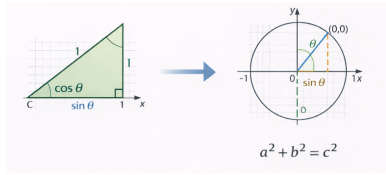
In trigonometry, Level 3 reasoning is characterized by the ability to operate with abstract definitions rather than concrete triangles. Students understand the unit circle as a foundational model for defining trigonometric functions for all real numbers. They can derive and manipulate identities such as
∠A+∠B+∠C=180∘
$$
\sin^{2}\theta + \cos^{2}\theta = 1
$$
and justify transformations of trigonometric expressions using algebraic and geometric reasoning.
At this stage, learners no longer rely on specific numerical examples or diagrams to validate claims. Instead, they evaluate arguments based on logical necessity. For instance, they can prove the Law of Sines or Law of Cosines from geometric principles and apply them to solve non-right triangles.
Cognitive behaviors typical of Level 3 include:
- Understanding the role of axioms, definitions, and theorems
- Constructing multi-step deductive proofs
- Evaluating the validity of mathematical arguments
- Operating flexibly across symbolic, graphical, and geometric representations
Reaching Level 3 marks the transition from procedural competence to genuine mathematical reasoning. However, research consistently shows that many secondary students remain at Level 2 even after completing formal trigonometry courses, highlighting the importance of carefully designed instructional sequences.
- Example (Level 2 task):
Students are given multiple right triangles of different sizes and asked to compare ratios of corresponding sides. Through this activity, they discover that the ratios remain constant, leading to the concept of trigonometric ratios.
- Example (Level 3 task):
Students are asked to prove the identity sin²x + cos²x = 1 using the unit circle definition, emphasizing formal deductive reasoning.
4. Expansion of the Triangle Concept in Middle School
4.1. Relational Reasoning through the Pythagorean Theorem
The introduction of the Pythagorean theorem marks a major cognitive transition. The triangle is no longer viewed only as a set of visible properties but as a structure governed by quantitative relationships. Students begin to understand that in a right triangle, the lengths of the sides are connected by a necessary mathematical relation. This corresponds to Van Hiele Level 2, informal deduction.
4.2. Trigonometric Ratios as Generalized Relationships
Through similarity, students learn that ratios of sides in right triangles remain constant regardless of size. The triangle becomes a means of expressing invariant relationships rather than a single concrete object. This stage prepares the conceptual ground for the formal notion of trigonometric functions.
5. From Triangles to Trigonometric Functions in High School
5.1. Formalization of Trigonometric Functions
In high school mathematics, trigonometric functions are defined using the unit circle rather than individual triangles. Although triangles appear to fade from view, they remain implicitly embedded in the definitions of sine, cosine, and tangent. Students are required to reason within a formal system of definitions and theorems, corresponding to Van Hiele Level 3[23].
5.2. Trigonometric Inequalities and Deductive Reasoning
Topics such as trigonometric inequalities require students to analyze conditions of existence and ranges of functions. The triangle concept, which began as a simple visual figure, now functions as an abstract logical structure within formal mathematical reasoning.
6. Educational Implications
The analyses presented in this study suggest several important implications for mathematics instruction.
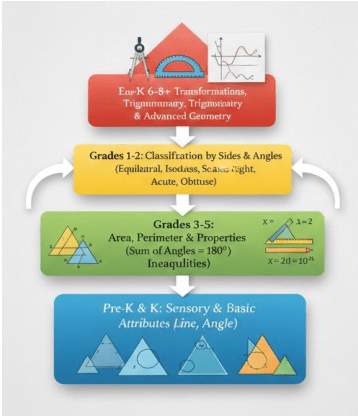
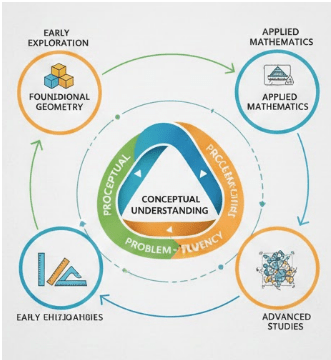
First, teachers should diagnose students’ current Van Hiele levels before introducing new geometric topics. If instruction on trigonometric functions is provided to students who remain at the visualization or simple analysis level, learning is likely to be mechanical and unstable. Figure 9 summarizes an integrated learning trajectory that aligns classroom activities with expected levels of reasoning [24-25].
Second, the continuity of the triangle concept should be emphasized explicitly throughout instruction. Rather than presenting trigonometry as a completely new domain, educators should highlight that it represents a generalization of relationships already encountered in right triangles.
Third, instructional materials need to employ diverse representations. Dynamic geometry environments, visual models, and contextual problems can help students connect perceptual images with formal definitions.
Fourth, assessment practices should evaluate relational and deductive understanding rather than only procedural skill. Tasks that require explanation of relationships among triangle properties or interpretation of trigonometric representations are particularly valuable.
Finally, teacher education programs should provide future teachers with opportunities to analyze curriculum sequences from a Van Hiele perspective. Understanding the long-term development of the triangle concept enables teachers to design lessons that promote genuine conceptual growth rather than short-term performance.
7. Conclusion and Suggestions for Further Research
The development of the triangle concept follows a coherent progression: from basic shape recognition to similarity-based reasoning, and ultimately to trigonometric functions defined on the unit circle.
This progression reflects an expansion from concrete geometric objects to abstract mathematical structures.
This study analyzed the development of the triangle concept in school mathematics using Van Hiele’s theory of geometric thinking levels. The analysis revealed that the triangle evolves from a perceptual object in elementary school to a relational structure in middle school and finally to an abstract deductive tool in high school. This progression aligns closely with the hierarchical structure proposed by Van Hiele.
The findings suggest that curriculum coherence in geometry is fundamentally cognitive rather than merely topical. Future research should empirically examine how instructional approaches based on this framework influence student understanding. In addition, comparative studies employing alternative theoretical perspectives, such as APOS theory or Duval’s semiotic representation theory, may further enrich interpretations of geometric concept development.
- M. T. Battista, “The development of geometric and spatial thinking,” in Second Handbook of Research on Mathematics Teaching and Learning, F. K. Lester, Ed. Charlotte, NC, USA: Information Age Publishing, 2007, pp. 843–908.
- W. F. Burger and J. M. Shaughnessy, “Characterizing the Van Hiele levels of development in geometry,” Journal for Research in Mathematics Education, vol. 17, no. 1, pp. 31–48, 1986, doi: 10.2307/749317.
- D. H. Clements and M. T. Battista, “Geometry and spatial reasoning,” in Handbook of Research on Mathematics Teaching and Learning, D. A. Grouws, Ed. New York, NY, USA: Macmillan, 1992, pp. 420–464, doi: 10.1108/978-1-60752-874-620251022.
- M. L. Crowley, “The Van Hiele model of the development of geometric thought,” in Learning and Teaching Geometry, K–12, M. Lindquist, Ed. Reston, VA, USA: National Council of Teachers of Mathematics, 1987, pp. 1–16.
- R. Duval, “Geometry from a cognitive point of view,” in Perspectives on the Teaching of Geometry for the 21st Century, C. Mammana and V. Villani, Eds. Dordrecht, Netherlands: Kluwer Academic, 1998, pp. 37–52.
- T. Fujita and K. Jones, “Learners’ understanding of the definitions and hierarchical classification of quadrilaterals: Towards a theoretical framing,” Research in Mathematics Education, vol. 9, no. 1–2, pp. 3–20, 2007, doi: 10.1080/14794800008520167.
- A. Gutiérrez, A. Jaime, and J. M. Fortuny, “An alternative paradigm to evaluate the acquisition of the Van Hiele levels,” Journal for Research in Mathematics Education, vol. 22, no. 3, pp. 237–251, 1991, doi: 10.2307/749076.
- R. Hershkowitz, “Visualization in geometry: Two sides of the coin,” Focus on Learning Problems in Mathematics, vol. 11, no. 1, pp. 61–76, 1989.
- K. Jones, “Critical issues in the design of the geometry curriculum,” in Readings in Mathematics Education, B. Barton, Ed. Auckland, New Zealand: University of Auckland, 2000, pp. 75–90.
- K. C. Moore, “Quantitative reasoning and the sine function: The case of Zac,” Journal for Research in Mathematics Education, vol. 45, no. 1, pp. 102–138, 2014, doi: 10.5951/jresematheduc.45.1.0102.
- Principles and Standards for School Mathematics. Reston, VA, USA: National Council of Teachers of Mathematics, 2000.
- N. Presmeg, “Research on visualization in learning and teaching mathematics,” in Handbook of Research on the Psychology of Mathematics Education, A. Gutiérrez and P. Boero, Eds. Rotterdam, Netherlands: Sense Publishers, 2006, pp. 205–235, doi: 10.1163/9789087901127_009.
- A. Sfard, “On the dual nature of mathematical conceptions: Reflections on processes and objects as different sides of the same coin,” Educational Studies in Mathematics, vol. 22, no. 1, pp. 1–36, 1991, doi: 10.1007/BF00302715.
- Z. Usiskin, Van Hiele Levels and Achievement in Secondary School Geometry. Chicago, IL, USA: University of Chicago, 1982.
- K. Weber, “Students’ understanding of trigonometric functions,” Mathematics Education Research Journal, vol. 17, no. 3, pp. 91–112, 2005, doi: 10.1007/BF03217423.
- M. Yerushalmy and D. Chazan, “Technology and curriculum design: The case of trigonometry,” in Research on Technology and the Teaching and Learning of Mathematics, M. K. Heid and G. W. Blume, Eds. Charlotte, NC, USA: Information Age Publishing, 2008, pp. 59–91.
- A. González, J. M. Gavilán-Izquierdo, I. Gallego-Sánchez, and M. L. Puertas, “A theoretical analysis of the validity of the Van Hiele levels of reasoning in graph theory,” Journal on Mathematics Education, vol. 13, no. 3, pp. 515–530, 2022, doi: 10.22342/jme.v13i3.pp515-530.
- A. P. Lumbre, M. N. Beltran-Joaquin, and S. L. C. Monterola, “Relationship between mathematics teachers’ Van Hiele levels and students’ achievement in geometry,” International Journal of Studies in Education and Science, vol. 4, no. 2, pp. 113–123, 2023, doi: 10.46328/ijses.61.
- F. T. D. Övez and E. Özdemir, “An examination of pre-service teachers’ Van Hiele levels of geometric thinking and proof perception types in terms of thinking processes,” Educational Research and Reviews, vol. 19, no. 1, pp. 26–39, 2024, doi: 10.5897/ERR2023.4386.
- T. Lutalo, Simplifying Grade 11 Trigonometric Ratios: An Analysis of Learners’ Errors, M.S. thesis, University of South Africa, South Africa, 2025.
- R. Selowa, Exploring Grade 10 Learner’s Spatial Skills of Computing Sides and Angles Figures Using Trigonometric Ratios, M.Ed. thesis, University of Limpopo, Limpopo, South Africa, 2023.
- K. Ayyaswamy, D. Madhavakumar, A. A. Raj, A. Nelson, N. Kathirvel, and S. Prathap, “An application of Pythagoras theorem from Heron’s formula to derive the foci of an ellipse,” in Educational AI Humanoid Computing Devices for Cyber Nomads. Hershey, PA, USA: IGI Global Scientific Publishing, 2025, pp. 73–98, doi: 10.4018/979-8-3693-8985-0.ch004.
- J. Hatt, Student Understanding of Trigonometric Functions: Exploring Understanding Through the Use of Contextual Tasks, Ph.D. dissertation, Syracuse University, Syracuse, NY, USA, 2024.
- A. Mukuka and B. Tatira, “Analysis of preservice teachers’ understanding of solving trigonometric equations: A perspective through actions, processes, objects, and schemas theory,” Pythagoras, vol. 46, no. 1, Art. no. 830, 2025, doi: 10.4102/pythagoras.v46i1.830.
- M. Genc and S. Ergan, “Teaching geometry through didactical situations: The case of the triangle inequality,” Acta Didactica Napocensia, vol. 15, no. 2, pp. 123–141, 2022, doi: 10.24193/adn.15.2.8.
No related articles were found.