
Dynamic Error Management in SAP: A Comprehensive Analysis

(This article belongs to the Section Software Engineering – Computer Science (SEC))
Export Citations
Cite
Kalabhavi, V. (2026). Dynamic Error Management in SAP: A Comprehensive Analysis. Journal of Engineering Research and Sciences, 5(3), 21–26. https://doi.org/10.55708/js0503003
Vinayak Kalabhavi. "Dynamic Error Management in SAP: A Comprehensive Analysis." Journal of Engineering Research and Sciences 5, no. 3 (March 2026): 21–26. https://doi.org/10.55708/js0503003
V. Kalabhavi, "Dynamic Error Management in SAP: A Comprehensive Analysis," Journal of Engineering Research and Sciences, vol. 5, no. 3, pp. 21–26, Mar. 2026, doi: 10.55708/js0503003.
Enterprise Resource Planning (ERP) systems, particularly SAP, face increasing demands for real-time operations and minimal downtime, necessitating sophisticated error management approaches. This paper examines the evolution from reactive to dynamic error management in SAP environments, analyzing theoretical frameworks and practical implementations. Through comprehensive literature review spanning 2000-2025, we explore hybrid error detection frameworks combining rule-based systems with artificial intelligence, achieving detection accuracies up to 94%. The study investigates process adaptation mechanisms, workflow management dynamics, and technical implementations leveraging SAP HANA capabilities. Key findings reveal that effective dynamic error management requires integration across technological, process, and human dimensions. The analysis demonstrates that hybrid frameworks combining traditional and AI-based approaches, coupled with real-time analytics and automated adaptation mechanisms, significantly enhance error detection and resolution capabilities. We propose recommendations for organizations implementing SAP systems, emphasizing predictive error management, ecosystem-wide integration, and democratization of error management capabilities. This research contributes to understanding dynamic error management as a strategic competence directly influencing business performance, customer satisfaction, and competitive advantage in contemporary enterprise environments.
1. Introduction
Enterprise Resource Planning (ERP) systems constitute the operational core of modern organizations, integrating critical business processes across finance, supply chain, human resources, and manufacturing domains. As the market leader in ERP solutions, SAP drives operations in the world’s largest and most complex business environments. However, the inherent complexity that empowers SAP systems simultaneously creates significant challenges in error detection, management, and resolution [1]. Organizations face mounting pressure for real-time operations, seamless integration, and zero-tolerance approaches to downtime, intensifying demands on error management capabilities.
Dynamic error management represents a paradigm shift from traditional reactive approaches toward proactive, adaptive, and intelligent models capable of anticipating, detecting, and automatically resolving problems in real-time [2]. Unlike conventional error management systems relying on established rules and manual processes, dynamic systems leverage emerging technologies—artificial intelligence, machine learning, and real-time monitoring—to deliver context-specific, automated responses to system anomalies [3].

Despite significant technological advances, a critical research gap persists regarding the integration of theoretical error management frameworks with practical SAP implementations. Existing literature addresses error detection [1], process adaptation [5], and workflow management [6] separately, yet comprehensive frameworks integrating these dimensions remain underdeveloped. This fragmentation limits organizations’ ability to implement holistic dynamic error management strategies.
1.1. Research Objectives
- Examine theoretical foundations of dynamic error management in SAP environments
- Analyze hybrid frameworks combining traditional and AI-based error detection approaches
- Investigate process adaptation and workflow management mechanisms for automated error resolution
- Evaluate technical implementations leveraging SAP HANA capabilities
- Develop recommendations for organizations implementing dynamic error management systems
This paper addresses these objectives through comprehensive literature review and synthesis, contributing to enterprise error management knowledge by bridging theoretical concepts with practical SAP applications.
2. Literature Review
2.1. Understanding Errors as Dynamic Processes
Traditional error management approaches have conceptualized errors as discrete, isolated incidents requiring individual resolution. Recent scholarship challenges this perspective, reconceptualizing errors as dynamic, interconnected processes evolving across temporal and organizational dimensions [2]. The error-as-process perspective integrates organizational science and operations management literature, providing nuanced insights into error emergence, propagation, and management within complex business contexts.
This approach recognizes errors not merely as technical failures but as fundamental organizational process components shaped by temporal relationships and dynamic interactions among systems, people, and procedures. In [2], the authors identify four critical pathways for integrative error management: temporal contextualization (acknowledging that identical errors carry different implications depending on when they occur within business processes), holistic process examination (analyzing errors within broader process contexts including upstream and downstream interactions), continuous monitoring and adjustment (recognizing errors’ dynamic nature requiring ongoing attention beyond one-time resolution), and bridging technical-organizational gaps (ensuring error management strategies address both technological failures and their organizational consequences).
However, limitations exist in translating this theoretical framework to SAP contexts, where technical complexity and integration demands create unique challenges. While reference [2] provide conceptual foundations, empirical validation within SAP environments remains limited, representing an area requiring further research.
2.2. Hybrid Error Detection Frameworks
Contemporary SAP ERP systems’ sophistication demands equally sophisticated error detection methodologies. Traditional rule-based systems effectively identify known error patterns but struggle with dynamic, evolving enterprise environments where novel error forms emerge regularly and system behaviors shift in response to changing business requirements [1].
Hybrid frameworks demonstrate significant promise addressing these limitations. In [1], the authors proposed an anomaly detection and dynamic clustering model for SAP ERP systems integrating multiple analytical methods, achieving detection accuracy of 94% and precision rates of 95.5%. These performance metrics validate sophisticated analytical approaches’ feasibility in operational SAP contexts. Hybrid frameworks’ strength lies in leveraging complementary error detection methods: rule-based systems excel at recognizing known error patterns and responding rapidly to familiar problems; machine learning algorithms detect novel patterns and aberrations representing previously unencountered issues; statistical techniques provide robust baseline measurements enabling anomaly detection in normal system performance [7].
Critical achievements include scalability (managing vast data volumes characteristic of large SAP installations without performance degradation) and interpretability (addressing machine learning’s black-box problem by providing actionable insights through intuitive visualizations bridging analytical results and operational decisions). The framework’s dynamic data stream adaptation capability proves essential in contemporary SAP environments where business processes, data volumes, and system configurations constantly evolve [1].
2.3. Process Adaptation Mechanisms
While anomaly detection identifies potential errors, effective management requires robust mechanisms for responding to and resolving detected errors. Dynamic adaptation enables systems to automatically modify behaviors in response to errors, exceptions, and varying conditions without complete process redesign or extensive manual intervention [3].
In [3], the authors proposed a generic process adaptation conceptualization for highly dynamic environments, introducing practical methodologies grounded in artificial intelligence planning for automatic anomaly handling. Their approach frames recovery program synthesis as classical AI planning problems, providing theoretically sound, mathematically rigorous foundations demonstrating correctness and completeness. This work’s significance lies in demonstrating that automated error recovery transcends mere practical engineering to rest on solid theoretical foundations.
Treating error recovery as planning problems enables systems to automatically generate recovery plans considering multiple factors: current system state, available recovery actions, and desired outcomes. This automated reasoning capability proves particularly valuable in complex SAP landscapes where manual error recovery can be time-consuming, error-prone, and heavily dependent on specialized expertise. Practical examples demonstrated theoretical framework correctness and completeness without compromising practical applicability—a critical balance for enterprise systems where reliability and usability determine success [3].
In [5], the authors complemented their work with service-oriented architectures for dynamic, flexible, extensible workflow exception handling, deploying workflow exception pattern taxonomies and offering exception-handling process repertoires encapsulated in self-contained units (exlets) dynamically invoked for specific error conditions. This architecture enables real-time management of anticipated and unforeseen exceptions, promotes exception-handling subprocess sharing across diverse workflows and applications, and facilitates model development without specification modification.
3. Methodology
This study employs a narrative literature review approach synthesizing theoretical frameworks, technical implementations, and empirical findings related to dynamic error management in SAP environments. The methodology encompasses systematic identification, analysis, and integration of relevant scholarly and practitioner literature published between 2000-2025.
3.1. Literature Search Strategy
Comprehensive searches were conducted across academic databases (ACM Digital Library, IEEE Xplore, SpringerLink) and practitioner sources using keywords: “SAP error management,” “dynamic error detection,” “ERP anomaly detection,” “workflow adaptation,” “process exception handling,” and “SAP HANA optimization.” Sources were selected based on relevance to SAP/ERP systems, methodological rigor, and contribution to dynamic error management understanding.
3.2. Analytical Framework
Selected literature was analyzed across five dimensions: (1) theoretical foundations examining error conceptualization and management frameworks; (2) technical approaches evaluating detection algorithms, adaptation mechanisms, and implementation technologies; (3) workflow integration assessing process management and change dynamics; (4) practical implementations reviewing real-world SAP applications; and (5) performance outcomes analyzing reported metrics and effectiveness indicators.
3.3. Synthesis Approach
Findings were synthesized to identify convergent themes, complementary insights, and research gaps. Integration focused on bridging theoretical concepts with practical SAP applications, developing comprehensive understanding of dynamic error management requirements, capabilities, and implementation considerations. This approach enabled holistic examination spanning conceptual frameworks to operational implementations while maintaining critical perspective on limitations and contradictions within existing literature.
4. Results & Discussion
4.1. Technical Implementation Performance
Analysis reveals significant performance improvements through dynamic error management implementations. Table 1 summarizes key performance metrics from reviewed studies, demonstrating substantial advances over traditional approaches.
Table 1: Performance Metrics of Dynamic Error Management Frameworks
| Framework | Accuracy | Precision | Performance Improvement | Source |
|---|---|---|---|---|
| Hybrid Anomaly Detection | 94% | 95.5% | N/A | [1] |
| SAP HANA Dynamic Pruning | N/A | N/A | 59% memory reduction | [7] |
| SAP HANA S/4HANA Queries | N/A | N/A | Up to 1000× speedup | [7] |
The hybrid framework proposed by [1] achieved 94% detection accuracy and 95.5% precision, substantially exceeding traditional rule-based systems’ capabilities. These metrics validate sophisticated analytical approaches’ feasibility in operational SAP environments. Performance improvements extend beyond detection accuracy to encompass system efficiency. In [7], the authors demonstrated that dynamic data integrity constraints and partition pruning in SAP HANA eliminated cold partitions and reduced memory usage by 59% across TPC-H queries. More dramatically, S/4HANA production applications exhibited up to three orders of magnitude speedup through dynamic partition pruning and constraint statistics—directly benefiting error management through faster query execution enabling more frequent system monitoring, reduced anomaly detection time, and accelerated error analysis.
4.2. Workflow Management Integration
Dynamic error management effectiveness depends critically on integration with workflow management systems. Table 2 presents workflow change types and their error management implications based on [6].
Table 2: Workflow Change Types and Error Management Implications (Adapted from [6])
| Change Type | Description | Error Management Implication |
|---|---|---|
| Flush | Overwrites current process instances with new ones | May resolve errors but risks discarding in-progress work |
| Abort | Terminates running processes | Required when errors cannot be corrected |
| Migrate | Transfers process instances to new definitions | Error-handling mechanisms must accommodate state transitions |
| Adapt | Modifies running processes to meet new requirements | Dynamic error detection must adjust to process changes |
| Build | Creates new process variants | Introduces new potential error conditions requiring identification |
Understanding these change types proves essential because each carries different implications for error detection and recovery. Flush operations may fix errors but risk work loss; Abort operations become necessary when errors prove uncorrectable; Migration requires error-handling mechanisms considering state transitions; Adaptation demands dynamic error detection adjusting to process modifications; Building creates new error conditions requiring identification and management [6].
4.3. Comparative Framework
Figure 2 illustrates the conceptual comparison between traditional and dynamic error management approaches.
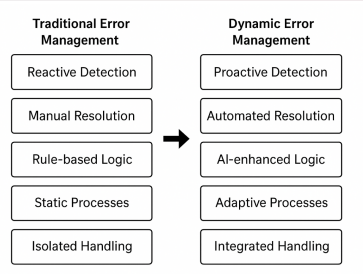
Traditional approaches rely on reactive detection identifying errors after occurrence, manual resolution requiring human intervention, rule-based logic limited to predefined patterns, static processes with fixed handling procedures, and isolated handling treating errors as discrete events. Dynamic approaches employ proactive detection anticipating errors before occurrence, automated resolution through intelligent systems, AI-enhanced logic adapting to novel patterns, adaptive processes adjusting to changing conditions, and integrated handling considering errors within broader process contexts.
4.4. Integration Challenges
Despite theoretical advances and technical capabilities, practical SAP implementation faces significant challenges. In [8], the authors documented that even with advanced SAP Integrated Business Planning (IBP) and S/4HANA Production Planning systems, implementations require extensive manual configuration and daily backup processes for data restoration. This reality highlights that dynamic capabilities must complement rather than replace human expertise and oversight.
Authorization management emerges as another critical integration dimension. Security and access control constitute integral error prevention and management components, not peripheral concerns. Unauthorized or inappropriate access creates error opportunities, whether malicious or accidental. Dynamic error management systems must integrate with existing security frameworks while providing necessary visibility and access for authorized personnel to diagnose and resolve errors [8].
4.5. Future Directions and Recommendations
Dynamic error management in SAP environments continues evolving rapidly, driven by artificial intelligence, cloud computing, and real-time analytics innovations. Five critical directions emerge from reviewed research and implementations.
4.5.1. Hybrid Framework Evolution
Integration of machine learning and AI-based approaches with traditional rule-based systems will intensify. Optimal approaches leverage hybrid frameworks combining known error pattern reliability with learning system adaptability. Organizations upgrading or implementing SAP systems should prioritize solutions delivering this hybrid capability, balancing stability with flexibility.
4.5.2. Predictive Error Management
Shift toward real-time, predictive error management will accelerate. Rather than identifying and responding to errors post-occurrence, future systems will progressively anticipate potential errors based on system state, historical behavior, and environmental context [2]. This predictive capability enables preventive interventions preventing errors from affecting business operations.
4.5.3. Ecosystem-wide Integration
Error management must span entire SAP ecosystems, encompassing cloud and on-premises components. As organizations adopt hybrid SAP landscapes integrating S/4HANA, cloud applications, and legacy systems, error management requires cross-platform capabilities enabling unified visibility and coordinated response [9].
4.5.4. Democratization of Error Management
Improved interfaces and automation will increase error management democratization. Systems enabling business users and process owners to participate without extensive technical expertise will become more prevalent and sophisticated [10]. This democratization accelerates response times while ensuring error resolution considers both technical and business perspectives.
4.5.5. Strategic Competence Recognition
Error management will be increasingly recognized as strategic competence rather than reactive necessity. Organizations will acknowledge that effective error management directly influences business performance, customer satisfaction, and competitive advantage, warranting strategic investment and continuous improvement [2].
5. Conclusion
Dynamic error management in SAP systems constitutes a critical capability for contemporary business environments demanding high-paced, interactive, and complex operations. The transition from reactive, manual error handling to proactive, intelligent, and automated error management reflects broader enterprise technology trends toward increased automation, intelligence, and adaptability.
This comprehensive analysis reveals that effective dynamic error management requires multi-level integration: theoretical frameworks conceptualizing errors as dynamic processes, hybrid technical mechanisms combining traditional and AI-based approaches for real-time error response, and practical implementations acknowledging enterprise SAP environment realities. Organizations implementing or upgrading SAP systems must approach error management holistically, considering technological, process, and human dimensions rather than treating it as isolated technical concern.
Investing in dynamic error management capabilities yields substantial benefits: reduced downtime, enhanced system reliability, improved user satisfaction, and increased SAP investment value. As SAP environment complexity and criticality grow, sophisticated error management importance will only intensify. The frameworks, technologies, and practices discussed herein provide foundations for organizations to build robust, flexible, and intelligent error management systems serving current demands while evolving to meet future requirements.
- A. Vaid, C. Reddy, and S. Prabhagaran, “A hybrid framework for dynamic clustering and anomaly detection in SAP ERP systems,” International Journal of Computer Science and Mobile Computing, vol. 13, no. 12, pp. 23 to 34, 2024. doi: 10.47760/ijcsmc.2024.v13i12.003.
- Z. Lei and E. Naveh, “Unpacking errors in organizations as processes: Integrating organizational research and operations management literature,” Academy of Management Annals, vol. 17, no. 2, pp. 798 to 844, 2023. doi: 10.5465/annals.2021.0066.
- M. De Leoni, M. Mecella, and G. De Giacomo, “Highly dynamic adaptation in process management systems through execution monitoring,” in Business Process Management, G. Alonso, P. Dadam, and M. Rosemann, Eds. Berlin, Heidelberg: Springer, 2007, pp. 160 to 175. doi: 10.1007/978-3-540-75183-0_14.
- J. Bullis, “22 ERP systems and software examples,” Cube Software, Sep. 12, 2025. [Online]. Available: cubesoftware.com/blog/erp-system-examples
- M. Adams, A. H. M. ter Hofstede, W. M. P. van der Aalst, and D. Edmond, “Dynamic, extensible, and context-aware exception handling for workflows,” in On the Move to Meaningful Internet Systems 2007: CoopIS, DOA, ODBASE, GADA, and IS, R. Meersman and Z. Tari, Eds. Berlin, Heidelberg: Springer, 2007, pp. 1046 to 1063. doi: 10.1007/978-3-540-76848-7_8.
- W. Sadiq, O. Marjanovic, and M. Orlowska, “Managing change and time in dynamic workflow processes,” International Journal of Cooperative Information Systems, vol. 9, no. 1 to 2, pp. 93 to 116, 2000. doi: 10.1142/S0218843000000077.
- A. Nica, R. Sherkat, M. Andrei, X. Chen, and M. Heidel, “Statistical: Data statistics management in SAP HANA,” Proceedings of the VLDB Endowment, vol. 13, no. 7, pp. 1001 to 1014, 2017. doi: 10.14778/3137765.3137772.
- R. Azmeera, “Demand planning integration best practices: SAP SCM perspective, part 4,” Journal of Artificial Intelligence and Cloud Computing, article SRC/JAICC-153, 2022. doi: 10.47363/JAICC/2022(1)141.
- M. Grube and M. G. Wynn, “Managing process change and standardization in ERP projects: An assessment of the SAP template approach,” International Journal on Advances in Intelligent Systems, vol. 13, no. 1 to 2, pp. 48 to 58, 2020. [Online]. Available: http://www.iariajournals.org/intelligent_systems/
- J. Hoffmann, I. Weber, and F. M. Kraft, “SAP speaks PDDL: Exploiting a software-engineering model for planning in business process management,” Journal of Artificial Intelligence Research, vol. 37, pp. 245 to 284, 2010. doi: 10.1613/jair.3636.